
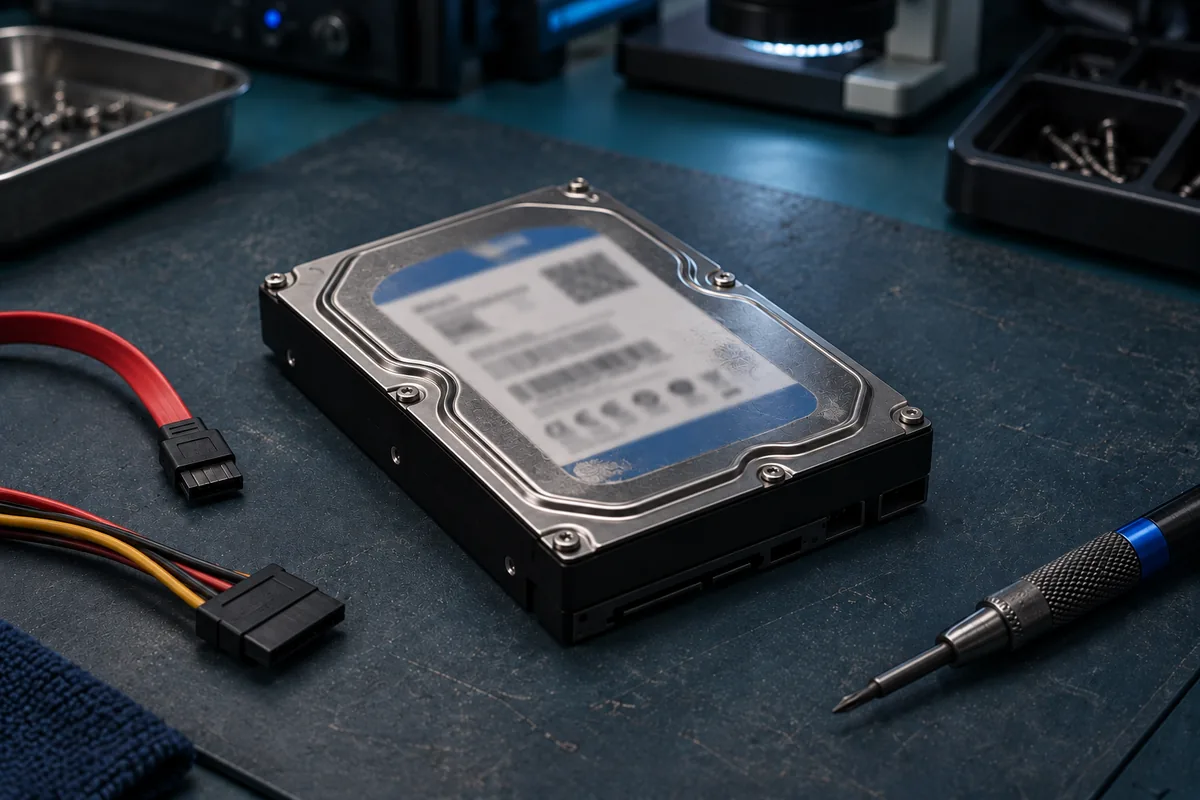
Yes — most failed hard drives are recoverable, including clicking, dropped, and undetected drives. At CBL, we recover HDDs in an in-house Singapore cleanroom using head replacement, PCB and firmware rework. Diagnosis is free, and you approve the fixed quote before any work begins. The critical first step: if your drive is clicking or was dropped, power it off now to avoid permanent damage.
Hard drive failed? Don't let a recoverable drive become a lost one.
Hard disk drives (HDDs) remain the most common — and most recoverable — storage device we see. But they're also mechanical: spinning platters, read/write heads floating nanometres above the surface, and delicate firmware. When one fails, the difference between a full recovery and permanent loss often comes down to what happens in the first hour.
Whether it's a laptop drive that took a knock, a desktop HDD that won't show up in Windows, or an external drive that's suddenly clicking, CBL's engineers have recovered from it before — over 140,000 successful recoveries in more than 20 years. We handle the full spectrum of failures, from simple logical corruption to catastrophic head crashes that require cleanroom surgery and donor parts.
If your drive is clicking, buzzing, grinding, or was dropped — power it off immediately and don't reconnect it. Every extra minute of power can scratch the platters and turn a recoverable drive into an unrecoverable one. Then book a free diagnosis.
This guide walks you through the warning signs, what's actually recoverable, our cleanroom process, honest pricing, and the DIY mistakes that destroy data — so you can make the right call for your files.
Signs your hard drive is failing
Some symptoms mean "back up now"; others mean "power off and call a lab immediately." Here's how to read them.
Any noise or physical symptom = power off and get professional help. Any software symptom on a healthy-sounding drive = stop using it and back up before it worsens.
Is your drive recoverable? Quick symptom check
Select what's happening with your drive for an instant read on the likely cause and next step.
Indicative guidance only — every drive is assessed individually at diagnosis.
Physical vs logical failure — and why it matters
Every hard drive failure is either physical (something mechanical or electronic broke) or logical (the hardware is fine but the data structure is damaged). Which one you have decides the recovery approach, the cost, and whether DIY is even safe.
| Physical failure | Logical failure | |
|---|---|---|
| Causes | Head crash, seized motor, PCB burnout, firmware corruption | Deletion, format, file-system corruption, bad sectors, RAW volume |
| Symptoms | Clicking, beeping, not spinning, not detected | Detected but inaccessible, missing files, "needs formatting" |
| Needs a cleanroom? | Yes — opening outside one destroys the drive | No — but imaging-first still applies |
| Safe to DIY? | Never | Sometimes, if a backup exists |
Not sure which you're facing? That's exactly what our free diagnosis determines. Read the full explainer: physical vs logical drive failure →
Hard drive repair or data recovery — which do you need?
People search for "hard disk repair", "HDD repair" and "hard drive repair near me" when a drive dies. It's worth understanding what repair means inside a data recovery lab — because it isn't the same as fixing an appliance.
✅ What we genuinely repair
- Read/write heads — replaced in the cleanroom with matched donor parts
- PCB / electronics — repaired or swapped, with the original ROM transferred
- Firmware — corrupt service areas rebuilt so the drive responds again
- Seized motors and stuck heads on dropped drives
- Corrosion on water-damaged boards
🛑 What repair does not mean
- We repair the drive to get your data off it — not to hand back a drive you keep using
- A drive that has physically failed should never be trusted again, repaired or not
- Your data is returned on fresh, healthy media
- We don't attempt "swap the board and hope" fixes that risk the platters
If someone offers to "repair" a clicking drive and give it back for continued use, be cautious. In a laboratory, repair is a means to recovery: we stabilise the drive just long enough to image it safely, then return your files on new media.
Looking for hard drive repair near me in Singapore? Our lab is at 6 Harper Road, Leong Huat Building #05-02 — beside Tai Seng MRT — with in-house cleanroom work, so your drive isn't sent overseas. Bring it in for a free diagnosis →
HDD data recovery, hard disk repair, hard drive Singapore — what people actually mean
People describe this problem in a dozen different ways, and the words matter less than you might think. If any of the phrases below sound like your situation, you are in the right place.
"HDD data recovery", "hard disk data recovery"
HDD simply stands for hard disk drive — the mechanical kind, with spinning platters and moving heads inside. HDD data recovery, hard disk data recovery and hard drive data recovery are all the same service. The abbreviation is common in IT circles; the plain words are more common everywhere else. Nothing about the job changes with the phrase you use.
"Hard disk repair", "hard disk drive repair", "portable hard disk repair"
These usually mean one of two very different things, and it is worth being clear which you want:
- Repairing the drive to keep using it. Honestly — don't. A drive that has failed once has demonstrated it will fail again. Even after a successful repair, it should not be trusted with anything you care about.
- Repairing the drive far enough to get the data off it. This is what we actually do. Heads, PCB, firmware and motor work are all means to an end: making the drive readable long enough to image it. The data then goes onto healthy media you keep.
So when we say we repair drives, we mean the second one. We are not in the business of returning you a refurbished drive to carry on using — see physical vs logical failure for what each type of damage needs.
"Retrieve data from hard disk", "recover files from hard drive"
Same thing again. Whether the drive is internal, external, portable or sitting in a laptop, the process is the same: diagnose the fault, stabilise the drive, image it sector by sector, then rebuild the file system from the image — never from the failing drive itself.
Not the words you use, but whether the drive is still being powered on. Every extra minute a physically failing drive spends spinning can turn a recoverable problem into an unrecoverable one. If it is clicking, beeping, or was dropped — unplug it and leave it alone.
Our hard drive recovery process
A disciplined, data-safe path — the original drive is imaged before any recovery is attempted, so it's never put at further risk.
Free diagnosis
We open the case (physically, in the cleanroom if needed), identify the exact failure, and tell you whether — and how — it's recoverable. No cost, no obligation.
Cleanroom work (if physical)
For head crashes we transplant a matched head-stack assembly from a donor drive; for electronic faults we rework the PCB or rewrite firmware — all inside our in-house cleanroom.
Sector-by-sector imaging
We clone the stabilised drive onto healthy media using specialised imagers that handle unstable, bad-sector drives gently — protecting your original.
File-system reconstruction
We rebuild the partition and file system from the image and extract your data, then give you a file list to verify.
Verify & return
Verified data is returned on fresh media. once you approve the quote.
See the full lab walkthrough: how professional data recovery works →
What we can recover — by failure type
| Failure type | What we do | Typical outcome |
|---|---|---|
| Deleted / formatted / corrupt (logical) | Image + file-system reconstruction | High |
| Clicking / failed heads (untouched) | Cleanroom head-stack replacement | High |
| PCB / electronics failure | Board rework, ROM transfer | High |
| Firmware corruption | Firmware/translator rebuild | Good |
| Dropped with platter damage | Cleanroom recovery of undamaged zones | Case-by-case |
| Previously opened / DIY-damaged | Assessed individually | Reduced |
Brand-specific quirks matter too — we handle Western Digital, Seagate, Toshiba, HGST and more, including hardware-encrypted and SMR drives.
How much does hard drive recovery cost?
Cost depends on the failure type — not a flat rate. Here are honest indicative ranges for hard drives so you're not walking in blind.
| Case type | Examples | Indicative range (SGD) |
|---|---|---|
| Logical | Deleted, formatted, corruption, bad sectors | $180 – $650 |
| Firmware / PCB | Not detected, electronic fault | $300 – $900 |
| Physical (head/motor) | Clicking, dropped, cleanroom head swap | $400 – $1,800 |
What moves the price within a range
Two clicking drives can land at opposite ends of the same band, and it is worth knowing why before you compare quotes.
- How far the damage has spread. A drive with one failed head reads faster and cleaner than one whose heads have already scored the platters. Powering a failing drive on repeatedly is what usually moves a case up a band.
- Whether donor parts are available. Head and PCB work needs a matching donor of the same model and firmware revision. Common Seagate and WD families are straightforward; obscure or very recent models take longer to source.
- Capacity and recording type. A 6TB drive simply takes longer to image than a 500GB one, and SMR drives — where tracks overlap like roof tiles — are slower and less forgiving to read.
- How much you need back. If only one folder matters, we can often target it and finish sooner. A full-volume rebuild is more work.
Logical recoveries are charged only if we actually recover your data. Physically failed drives that need donor parts carry a small non-refundable parts deposit of $80–$250 depending on the model, and we show you that figure up front rather than adding it later.
We confirm the exact fixed price before any work begins. Full details on our data recovery cost guide →
DIY mistakes that destroy hard drives
The internet is full of "hard drive fixes" that permanently kill recoverable data. Please don't.
DIY software is fine for a healthy drive with a minor deletion and a backup elsewhere — nothing more. See DIY vs professional recovery →
Hard drive recovery case studies
Representative examples drawn from typical laboratory cases. Devices and details anonymised.
Clicking Seagate — 12 years of family photos
A 2TB Seagate started clicking mid-backup. Failed read/write heads. In the cleanroom we fitted a matched donor head-stack, imaged the platters, and rebuilt the file system.
✓ 99% recoveredWD drive not detected — active projects
A WD desktop drive stopped being detected after a power surge. The fault was a burnt PCB; we reworked the board and transferred the unique ROM to restore access.
✓ 100% recoveredDropped external drive, DIY already attempted
An external HDD was dropped, then run through recovery software twice. We assessed the head damage, recovered the intact zones in the cleanroom, and salvaged the critical accounts.
✓ Critical data recoveredReal hard drive recoveries
From verified 5★ reviews on our Google Business Profile. Names as published on Google.
Rare donor parts tracked down for two damaged drives
Two seriously damaged hard disks — one WD, one Toshiba — needed parts that were difficult to source. The team worked patiently through sourcing them and recovering the data, and showed the files for checking before any payment was made.
✓ ~95% recovered20 years of family photos, back again
Data retrieval from an old hard drive came back almost 100%. The part that mattered most was a 20-year family photo collection, recovered intact.
✓ Almost 100% recoveredFaulty Toshiba, paid only after the recovery
A faulty Toshiba hard disk. Most of the data was recovered, and payment was only taken after the recovery was complete.
✓ Most data recoveredThese are real reviews from our customers on Google (4.9★ from 909), shown as testimonials.
CBL vs a reseller vs DIY software
| What matters | CBL (in-house lab) | Typical reseller | DIY software |
|---|---|---|---|
| Cleanroom head-stack work | ✓ On-site | ✗ Outsourced | ✗ None |
| Donor parts for head swaps | ✓ In stock | Sent elsewhere | ✗ |
| Safe on a clicking drive | ✓ Images first | Varies | ✗ Destroys data |
| Best for | Any HDD failure | Simple cases | Minor logical + backup exists |
Free diagnosis & a fixed written quote
Free Diagnosis
We assess your drive and identify the failure — no cost, no obligation.
Work Stays In-House
Recovered in our in-house Singapore lab — never shipped overseas.
Fixed Quote First
A firm written price before any work begins. No hidden fees.
Hard drive recovery FAQ
Is HDD data recovery the same as hard drive data recovery?+
Can you repair my hard disk so I can keep using it?+
Do you handle portable and external hard disks as well as internal ones?+
Can you recover a dead hard drive?+
My hard drive is clicking — what does it mean?+
Does the freezer trick work?+
Can you recover a drive that isn't detected?+
Do you replace read/write heads?+
How much does hard drive recovery cost?+
If the hard drive cannot be recovered, do I still pay?+
Which brands do you recover?+
How long does it take?+
My drive got wet — can you still recover it?+
Two badly damaged hard disks — a WD and a Toshiba — needed rare donor parts. CBL took the patience and care to source them and work through the recovery. — T M K Guwe ★★★★★ · More real case studies →
The bottom line
A failed hard drive is rarely the end of your data — but the wrong first move can be. With 20+ years, 140,000+ recoveries, an in-house Singapore cleanroom, transparent pricing, CBL gives your drive its best chance. Power it off, and let's take a look — free.
What we do — and what we don’t
CBL Data Recovery (S) Pte Ltd (UEN 201101007Z) is the service provider — not a reseller, referral service or agent. We are a data recovery laboratory. You bring or ship your storage device to our own lab at 6 Harper Road, Leong Huat Building #05-02, beside Tai Seng MRT. Our own engineers image the media in our in-house cleanroom and return your recovered files.
We do not provide remote access or remote sessions, telephone troubleshooting, virus or malware removal, password resets, account recovery, software installation, or device repair, and we sell no software or subscriptions. Any physical work on your media is carried out solely to bring it to a readable state so it can be imaged — you receive your recovered files, not a repaired device.
We do not bypass encryption or account security. Where a device is encrypted, recovery requires the owner’s own password or key. Diagnosis is free, and all work is quoted in writing before it begins.