
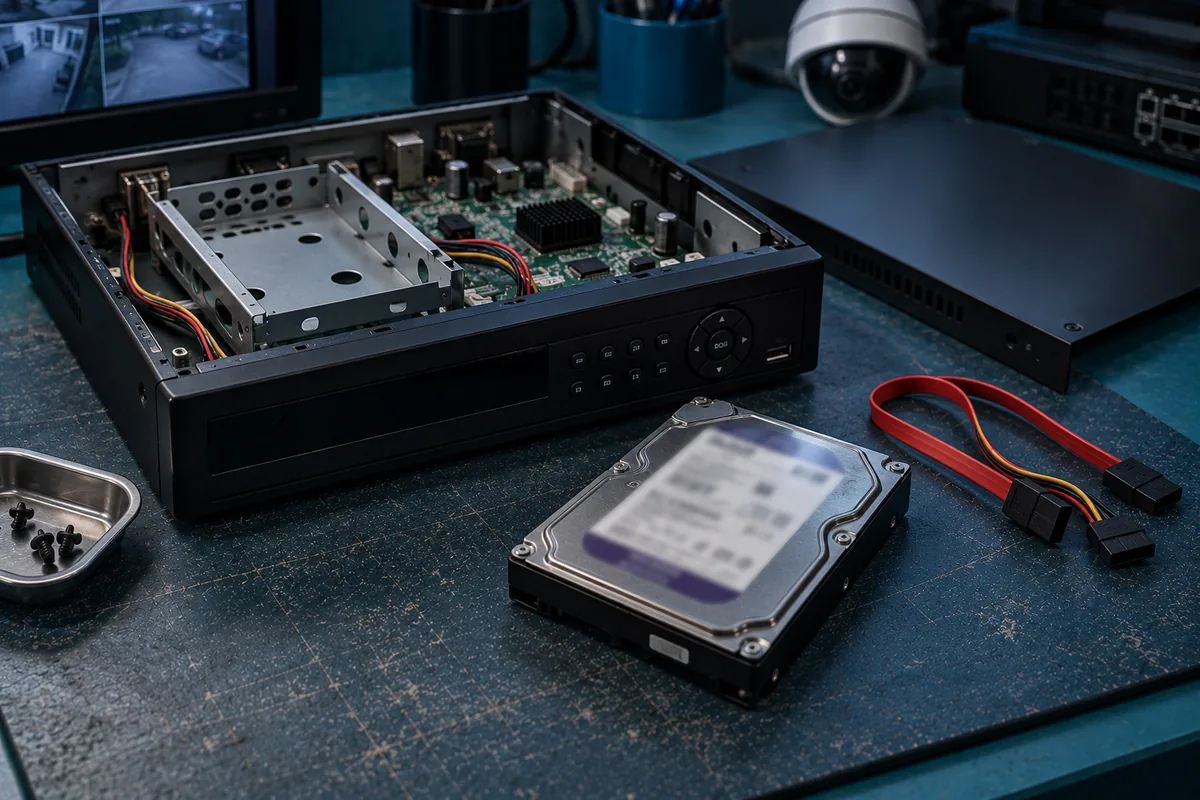
Yes — deleted, overwritten-recently and failed-drive CCTV footage is often recoverable, including proprietary DVR/NVR formats from Hikvision, Dahua and others. But CCTV systems record on a loop and overwrite old footage continuously — so the single most important step is to power the recorder down immediately to preserve what's left. Then bring it to us for a free diagnosis.
Surveillance footage you need — recovered from the recorder.
When something happens on camera — a theft, an accident, a dispute — the footage on your DVR or NVR can be critical. But CCTV recorders don't store video like a normal computer: they use proprietary filesystems and record on a continuous loop, overwriting the oldest footage to make room for the new.
CBL recovers CCTV footage from failed recorder hard drives, deleted or corrupted recordings, and proprietary DVR/NVR formats across all major brands. We rebuild the video from the recorder's disks — including footage from a specific date, time or camera channel.
CCTV overwrites old footage on a loop. Every minute the system stays on, more of your footage is erased. Power it down, remove the hard drive if you can, and contact us urgently.
Why speed matters: the overwrite loop
Unlike deleted files on a computer — which can sit recoverable for a long time — CCTV footage is on a countdown. The recorder is actively overwriting the oldest recordings every second it runs. The sooner the system is powered off and brought to us, the more footage we can recover. If the incident is recent, act immediately.
CCTV data recovery Singapore, DVR recovery, NVR data recovery — what people actually mean
People describe this problem in a dozen ways, and the words matter far less than which box is sitting in your riser cupboard.
"CCTV data recovery Singapore", "CCTV footage recovery", "surveillance video recovery"
All the same job: getting video off the storage inside a surveillance system. What genuinely varies is which storage — and that changes the method, the price and the odds.
DVR, NVR, or a camera's own SD card?
- DVR (digital video recorder). Analogue cameras run on coax back to one box, and that box encodes and stores the video on a single internal hard drive. DVR recovery therefore usually means one surveillance HDD, 1TB to 8TB, written in a proprietary layout.
- NVR (network video recorder). IP cameras stream over Ethernet to a recorder that may hold two, four or eight drives, sometimes striped or spanned together. NVR data recovery is closer to RAID recovery: we often have to work out the disk order and stripe geometry before a single frame appears.
- A standalone camera, doorbell or dashcam with its own card. No recorder involved at all — that is SD card recovery, with different failure modes and usually the lowest cost of the three.
Not sure which you have? Count the cables. Coax with screw-on BNC plugs into one box means DVR. Network cables into a PoE switch or into LAN ports on the recorder means NVR.
"CCTV repair" is the opposite of CCTV footage recovery
An installer repairs the system so it records again from today. We recover the footage already on the disk. Doing the first often destroys the second: reinitialising the recorder or fitting a fresh drive gets your cameras live again, but the incident you needed is written over. Get the footage out first, then let your installer restore the system.
"Hikvision recovery", "Dahua recovery"
The brand names describe the format, not the hardware. The disk inside is an ordinary SATA hard drive. What makes it unreadable on a PC is the manufacturer's own on-disk layout — so the brand matters a great deal for the software side of the job, and not at all for the mechanical side.
Not the phrase you search for, but whether the recorder is still powered on. A DVR never sits idle. Ten hours of deciding what to do can be ten hours of the incident gone.
What a failing recorder does before the footage goes
Surveillance recorders rarely die politely. They usually give weeks of small symptoms first, and each one points at a different fault.
- Gaps in the playback timeline. The search calendar shows recording on some days and blank stretches on others. Usually bad sectors — the drive skips the region it can no longer write to. This is the earliest warning and the most ignored.
- "No HDD" or "HDD error" on screen, with the buzzer beeping. The recorder can no longer see the disk, either because it has dropped off electrically or because its firmware area is damaged. Do not let the menu format it.
- Live view works, playback does not. The cameras and encoder are fine; the storage or the recording index is not.
- Export fails partway, or produces a 0KB file. The clips are being read from damaged areas, and every retry drags the heads back over the same weak sectors.
- Clicking or a rhythmic tick from inside the box. Mechanical head failure in the drive. Power the unit off — see hard drive clicking noise.
- The recorder reboots in a loop. Often a stalling drive holding up the boot sequence, sometimes a failing power supply. Both are hard on the disk.
Brands & formats we recover
Every major recorder brand writes video in its own on-disk format. None of them use NTFS, exFAT or ext4 — which is why a DVR disk plugged into a Windows PC looks blank or unformatted. Recovering it means rebuilding that format, not simply undeleting files.
What the brand changes
- Hikvision. Video sits in large pre-allocated blocks with its own index near the front of the disk. Where that index is damaged, we identify the blocks and rebuild the timeline from the stream headers themselves.
- Dahua. A different block layout, with per-channel streams. Channel and timestamp mapping lives in structures we parse separately from the video data.
- Uniview, TVT and generic OEM boards. Common in budget installs here. Many share a handful of reference designs, so the format is often recognisable even when the badge on the box is not.
- Samsung / Hanwha and Bosch. Enterprise recorders with their own formats and, on larger systems, multi-disk volumes that must be reassembled before any footage can be read.
Surveillance-grade drives still fail
Most recorders ship with a WD Purple or Seagate SkyHawk — drives tuned for continuous sequential writing, with streaming commands that let a frame drop rather than stall the recording. That tuning helps. It does not make them immortal. They run 24/7 for years in a hot ceiling void or a dusty riser, often on unprotected mains, and in a multi-bay NVR they sit in each other's vibration. They reach us with bad sectors, seized motors and failed heads like any other hard drive.
Why CCTV footage is lost
Two of these hold still and two are races against the clock. A failed drive or a corrupted filesystem stops the system writing, so the footage stays where it is until we image the disk. Deleted footage and a recorder that has been reset are different: in both cases the unit is usually still running, and every new frame lands on top of the old one.
Our CCTV recovery process
Free diagnosis (urgent)
Bring in the recorder or its hard drive. We assess the fault and confirm what footage is recoverable — with priority for time-critical incidents.
Image the drive
We clone the surveillance drive first — repairing it in the cleanroom if it has physically failed — so the original is never risked.
Rebuild the proprietary format
We reconstruct the DVR/NVR's proprietary filesystem and reassemble the fragmented H.264/H.265 video streams.
Extract footage
We extract the requested cameras, dates and times as playable video, and provide a list to verify.
Secure return
Footage returned confidentially on fresh media.
The recorder's drive is a hard drive at heart — see hard drive recovery.
DIY mistakes that destroy CCTV footage
Surveillance systems invite tinkering — the recorder has a menu, the drive is four screws away. These are the mistakes we see most often, and what each does to your footage.
- Leaving the recorder running while you decide. The single biggest destroyer of evidence. Loop recording does not pause because something important happened.
- Plugging the DVR drive into a Windows PC "just to look". Windows cannot read the proprietary format, so it reports the disk as uninitialised and offers to fix it. Accepting writes a new partition table over the recorder's index. Even if you decline, Windows writes volume metadata to disks it mounts.
- Formatting from the recorder's own menu. An "HDD error" prompt tempts you into a format. That clears the index and restarts recording at the beginning of the disk.
- Running consumer recovery software over it. Those tools hunt for NTFS, FAT and known file signatures. A surveillance disk has none of them, so you get nothing, or a heap of unplayable fragments.
- Letting someone reconnect the old drive to "test" it. Powering a failing drive up repeatedly for another look is how a recoverable head fault becomes scored platters.
The "HDD error — format now?" prompt on a DVR menu is the most common way surveillance footage is lost for good. Power the unit off instead and talk to us first.
DIY software has a place on a healthy computer disk with a minor deletion and a backup elsewhere. It has almost none on a surveillance drive — see DIY vs professional recovery →
Evidence handling & confidentiality
Incident & Legal Cases
We handle footage for insurance claims, disputes and police/court matters with care.
Confidential & PDPA-Aware
Surveillance footage handled confidentially, with NDAs for business clients.
Urgent Turnaround
Priority service for time-sensitive incidents before more footage is lost.
Exporting footage an insurer, a landlord or the police can actually use
Recovered footage only helps if the other side can open it. Where we can, we return two versions: the native clips in the recorder's own format, which keep the embedded channel and time data intact, and a converted copy in a standard player format so nobody needs the manufacturer's software to watch it. We also extract the continuous span either side of the incident rather than one clipped moment — context is usually what settles a claim.
Timestamps matter more than people expect
Recorder clocks drift, and many are never reset after a power cut; few small installs are synchronised to a time server at all. If the DVR clock was forty minutes slow, the clip labelled 3:10pm is really 3:50pm — and anyone comparing it against a receipt or a door log will notice. We give you the time the recorder wrote, not a time we invent, and we flag it when the clock looks wrong so you can state the offset yourself.
Give us the date, the approximate time and which camera. That lets us prioritise the right region of the disk and check first whether the footage still exists — before you commit to anything.
How much does CCTV recovery cost?
| Case type | Examples | Indicative range (SGD) |
|---|---|---|
| Logical / deleted footage | Deleted clips, corrupt filesystem, healthy drive | $180 – $650 |
| Failed surveillance drive | Clicking/dead DVR HDD needing cleanroom | $400 – $1,800 |
| NVR RAID / complex | Multi-disk NVR, large arrays | $1,200+ |
Exact fixed price before work begins. Full detail: data recovery cost guide →
CBL vs a CCTV installer vs DIY software
Your installer is the right person to get the cameras recording again. They are usually not equipped to get lost footage back, and most of them will say so.
| What matters | CBL (in-house lab) | CCTV installer | DIY software |
|---|---|---|---|
| Rebuilds proprietary DVR/NVR formats | ✓ In the lab | Playback tools only | ✗ Sees an unformatted disk |
| Cleanroom repair of a failed drive | ✓ On-site, never sent overseas | ✗ | ✗ None |
| Works on an image, not your original | ✓ Images first | Varies | ✗ Writes to the disk |
| Reassembles a multi-disk NVR volume | ✓ | Rarely | ✗ |
| Best for | Footage that matters | Getting the cameras live again | Little use on a surveillance disk |
CCTV recovery case studies
Representative examples from typical laboratory cases. Anonymised.
Deleted footage of a shop incident
Footage of a theft was deleted from a Hikvision DVR. The owner powered it down quickly; we rebuilt the proprietary format and recovered the relevant clips.
✓ Incident footage recoveredFailed DVR hard drive
A warehouse DVR's WD Purple drive started clicking. We cleanroom-repaired it, imaged the platters and extracted footage from the required date range.
✓ Footage recoveredNVR RAID after power surge
A multi-disk NVR went offline after a power surge. We reconstructed the array and extracted the requested camera channels.
✓ Channels recoveredFree diagnosis & a fixed written quote
Free Diagnosis
We assess your recorder and confirm what's recoverable — no cost.
Work Stays In-House
Recovered in our in-house Singapore lab — never shipped overseas.
Urgent Handling
Priority service for time-critical incidents.
CCTV recovery FAQ
Can you recover deleted CCTV footage?+
How long before footage is overwritten?+
Can you recover from a failed DVR hard drive?+
Do you recover Hikvision and Dahua formats?+
Can you recover footage from a specific date and camera?+
Can the footage be used for insurance or court?+
How much does CCTV recovery cost?+
If the footage cannot be recovered, is there a charge?+
Can I plug the DVR hard drive into my PC to see what's on it?+
Once the recorder has looped over the footage, is it really gone?+
One drive in my NVR shows as failed — is everything lost?+
Should I bring the whole recorder or just the hard drive?+
Do WD Purple and Seagate SkyHawk drives fail less often?+
The bottom line
CCTV footage is recoverable — but it's on a countdown. The moment an incident matters, power the recorder off to stop it overwriting, and bring it to CBL. With proprietary-format expertise and urgent handling, we give your footage its best chance.