
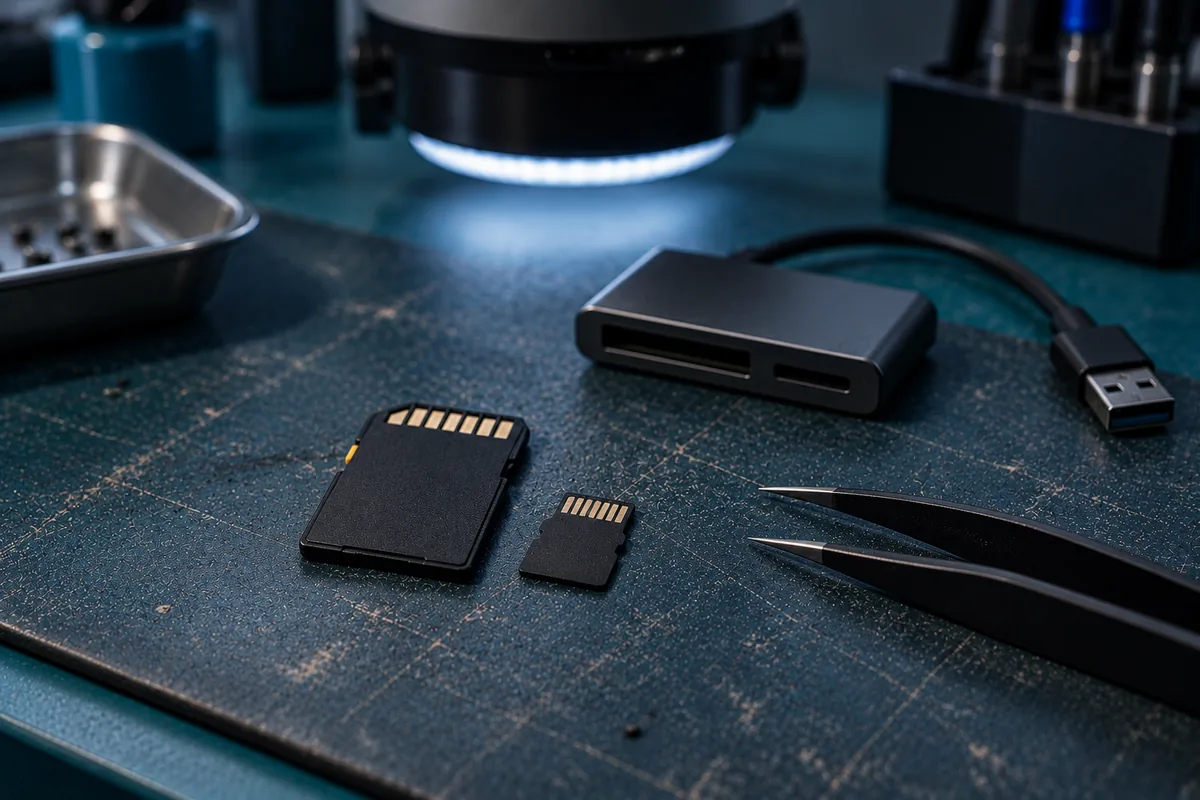
Yes — corrupted, unreadable and physically damaged memory cards are usually recoverable, including deleted photos and videos, cards that ask to be formatted, and snapped or water-damaged cards. For monolithic cards we read the NAND directly via chip-off. The most important thing: stop using the card immediately — every new photo or video can overwrite what we need.
Irreplaceable photos on a card that won't read? We can help.
Memory cards hold some of the hardest-to-replace files there are — a wedding shoot, a once-in-a-lifetime trip, a client project. When a card suddenly shows as empty, asks to be formatted, or won't mount, the panic is real. In most cases, though, your photos and videos are still on the NAND flash inside.
CBL recovers every card format — SD, microSD, CompactFlash, CFexpress and XQD — from logical corruption to physically damaged and monolithic cards. When a card can't be read normally, we read the raw NAND directly and rebuild your images and footage, including fragmented 4K video.
Don't take more photos, don't format it, and don't "repair" it. New writes can overwrite your recoverable files. Remove the card, keep it safe, and book a free diagnosis.
SD card recovery Singapore, memory card recovery, microSD card recovery — what people actually mean
People describe this problem in a dozen different ways, and the wording matters far less than what the card is physically doing. If any of the phrases below sound like your situation, you are in the right place.
"Memory card recovery", "SD card recovery Singapore", "flash card recovery"
All the same job. SD is a standard, not a brand — it stands for Secure Digital. A full-size card in a DSLR and a microSD in a dashcam store files the same way: on NAND flash chips, managed by a small controller that decides where each block of data physically lives. Recovery means getting your files back off that NAND, whatever label is printed on the outside.
"Corrupted SD card" versus a damaged card
Worth separating, because the two need very different work. A corrupted SD card still powers up and is seen by the computer — the file table is scrambled, so the card shows as empty, shows as RAW, or asks to be formatted. That is a logical case and reconstruction usually goes well. A damaged card is one the reader cannot talk to at all: snapped, water-soaked, or with a dead controller. That needs physical work, up to and including chip-off.
"SD card repair" and "fix my memory card"
This is the confusion worth settling. Repair tools, in-camera repair functions and the format prompt all try to make the card usable again — and they achieve that by writing a clean file system straight over your photos. Recovery does the opposite. We never write to the card; we read it and rebuild the files somewhere else. If the photos matter more than the card, you want recovery, not repair. A card that has failed once should be retired either way.
"microSD card recovery", "TF card recovery"
TF (TransFlash) is just the old name for microSD — the cards are identical. microSD card recovery differs from full-size SD in one important respect: most microSD cards are monolithic, which changes the physical method entirely.
Not the words you use, but whether the card is still being written to. Every new photo, every format, every repair attempt can overwrite the files we are trying to reach. Take the card out and leave it out.
Memory cards & devices we recover
The form factor decides how we get the data out
- Full-size SD. A plastic shell holding a small board with a separate NAND chip and controller. If the controller dies we can often still reach the NAND directly, which makes these the most forgiving cards we see.
- microSD. Nearly always monolithic — die, controller and contacts moulded into one solid block with nothing to lift off. Recovery means locating the internal test pads and reading the die through them: slower, far more delicate, and not always possible.
- CompactFlash. Older professional cards with a pin block that bends if the card enters the slot slightly off-angle. Bent pins are common and usually fixable.
- XQD and CFexpress. NVMe-based cards in Nikon, Sony and Canon bodies shooting 4K and 8K. They behave like a tiny SSD, so controller and firmware faults dominate rather than simple corruption.
Camera, phone and dashcam cards fail differently
A camera card is written in large sequential bursts and usually has an easy life. A phone microSD is read and written constantly by dozens of apps, so its directory structures fragment badly. A dashcam card is the hardest of the three — loop recording erases and rewrites the same blocks around the clock, so wear arrives years earlier. If a dashcam card holds footage you need, take it out of the camera the moment the incident happens. For footage sitting on a recorder rather than a card, see CCTV and DVR recovery.
Card brands, models and controllers we recover
The name on the label matters less than the controller underneath it, but each family has behaviours we recognise before the card is even opened.
- SanDisk — Extreme, Extreme Pro and Ultra. SanDisk uses its own controllers and its own internal data layout, so a raw NAND read has to be reassembled with the correct algorithm, not simply dumped.
- Samsung — EVO, EVO Plus and PRO microSD, heavily used in phones, drones, dashcams and the Nintendo Switch. Monolithic construction, so a dead Samsung microSD is pad-read work or nothing.
- Lexar — Professional SD, CFexpress and older UDMA CompactFlash. Controller failure that leaves the card reporting 0 MB is the classic Lexar case.
- Kingston — Canvas Select and Canvas Go, plus a long tail of older SD cards. Wrong-capacity reporting after a firmware fault is common.
- Sony — Tough series SD and CFexpress Type A from Alpha bodies. The sealed one-piece Tough design is good for the photographer and awkward for us; it has to be opened slowly and precisely.
We also handle Transcend, PNY, Integral, Delkin, ADATA and the unbranded cards bundled with dashcams and action cameras. If the NAND is intact, the brand rarely stops us.
Counterfeit and fake-capacity cards
A steady share of the cards that reach us were never what the packaging claimed. A counterfeit card is typically a genuine 8GB or 32GB chip running hacked firmware that reports 512GB or 1TB to the camera. Everything looks normal until you pass the real capacity — then writes wrap around and silently overwrite the earliest files. There is nothing left on the NAND in that region, and we will tell you so plainly rather than charge you to find out.
Suspiciously cheap high-capacity cards from marketplace sellers are the usual source. If a card reports a capacity the brand does not actually sell, or files written months ago have vanished on their own, treat it as suspect and stop using it.
Symptoms of a failing or corrupted SD card
Cards usually give some warning before they go completely. Here is what each symptom normally indicates.
Why cards wear out in the first place
Every NAND cell tolerates a finite number of erase cycles. The controller spreads writes across the chip to even out that wear and quietly retires blocks as they fail. When the spare blocks run out — or when the controller's own mapping tables are corrupted by a power cut mid-write — the card stops making sense to the reader. That is why a card fine for three years can fail in a single afternoon: the wear was invisible until the margin ran out. Pulling a card while the camera light is still on is the single most common trigger we hear, because the controller is mid-update to that mapping table when the power disappears.
A card that is still readable means copy everything off now, then stop using it. A card that is not detected, showing the wrong size, or asking to be formatted means stop entirely and have it diagnosed — every further attempt narrows what is left.
What NOT to do with a failing card
Why each of these destroys data
These are not superstitions. Each one has a specific mechanism.
- Agreeing to "format this card". Formatting writes a fresh, empty file system over the directory area — precisely the region we use to rebuild your folder structure and filenames. The image data often survives, but a named, organised recovery becomes carving nameless fragments out of raw blocks.
- In-camera repair or "recover image". These functions write to the card. On a card whose controller is already struggling they can also trigger further block retirement, shrinking what is still readable.
- Running CHKDSK on a card. CHKDSK exists to make a volume mountable again, not to preserve data. On a corrupted card it commonly dumps your photos into FOUND.000 as numbered fragments with the names and folders gone.
- Running recovery software over and over. Each pass keeps a dying card powered and reading, which accelerates the failure — and many tools helpfully write their own results back to the same card.
- Heat, rice or a hairdryer on a wet card. Heat warps the plastic and drives moisture further under the epoxy, while corrosion carries on regardless. Keep it sealed and cool and bring it in.
- Bending a snapped microSD straight, or soldering it. The die inside a monolithic card is a silicon wafer. Flexing it cracks the die, and cracked silicon cannot be read by anyone.
Software is fine on a healthy card with a simple deletion and a backup elsewhere — nothing beyond that. See DIY vs professional recovery and our honest look at data recovery software.
Our card recovery process
Free diagnosis
We identify the fault — logical, controller or physical — and confirm recoverability. No cost, no obligation.
Image or access
If the card still reads, we image it immediately; if not, we attempt controller access.
Chip-off (if needed)
For dead or monolithic cards we read the raw NAND directly and reconstruct the data with the card's wear-levelling/ECC scheme.
Rebuild photos & video
We reconstruct the file system and repair fragmented images and 4K video, then give you a list to verify.
Verify & return
Verified files returned on fresh media.
More on the lab: how professional data recovery works →
What we can recover — card scenarios
| Scenario | Method | Typical outcome |
|---|---|---|
| Deleted photos/videos (card unused since) | File-system recovery | High |
| Corrupt / RAW / "format card" | Logical reconstruction | High |
| Not detected / controller failure | Access or chip-off | High |
| Snapped / water-damaged card | Chip-off / monolith | Case-by-case |
| Formatted & heavily overwritten | Assessed individually | Reduced |
Also recovering USB drives? See USB recovery, or deleted file recovery.
How much does card recovery cost?
| Case type | Examples | Indicative range (SGD) |
|---|---|---|
| Logical | Deleted, corrupt, RAW, "format card" | $150 – $500 |
| Controller / not detected | Card not recognised | $200 – $600 |
| Chip-off / monolith | Dead, snapped or water-damaged card | $200 – $600 |
Exact fixed price before work begins. Full detail: data recovery cost guide →
Card recovery case studies
Representative examples from typical laboratory cases. Anonymised.
CFexpress "card error" after a shoot
A CFexpress card corrupted mid-wedding. We imaged it, rebuilt the file system and repaired the fragmented RAW photos and 4K video.
✓ Full shoot recoveredmicroSD asking to format — holiday photos
A phone microSD showed as empty and asked to format. We reconstructed the file system without formatting and returned the holiday album.
✓ Photos recoveredSnapped monolithic microSD
A snapped microSD from a drone shoot. We performed monolith chip-off and rebuilt the footage.
✓ Footage recoveredCBL vs a camera shop vs DIY software
Three very different things get called "card recovery". This is what separates them.
| What matters | CBL (in-house lab) | Camera shop / reseller | DIY software |
|---|---|---|---|
| Chip-off and monolithic microSD | ✓ In-house | ✗ Sent onward | ✗ None |
| Reads raw NAND and rebuilds it | ✓ With the controller's own scheme | Varies | ✗ Needs the card to mount |
| Safe on a card that is not detected | ✓ Reads, never writes | Varies | ✗ Keeps a dying card powered |
| Repairs fragmented RAW and 4K video | ✓ | Rarely | ✗ Exports broken clips |
| Best for | Any card failure, physical or logical | Simple deletions | Healthy card, backup already exists |
More on choosing between them: how to choose a data recovery lab in Singapore →
Free diagnosis & a fixed written quote
Free Diagnosis
We assess your card — no cost, no obligation.
Work Stays In-House
Recovered in our in-house Singapore lab — never shipped overseas.
Fixed Quote First
A firm written price before any work begins. No hidden fees.
Card recovery FAQ
Can you recover photos from a corrupted SD card?+
My card says "format" — should I?+
Can you recover deleted or formatted photos?+
Do you do chip-off for monolithic cards?+
Can you recover 4K video and RAW photos?+
How much does card recovery cost?+
Do I pay if the memory card turns out to be unrecoverable?+
What is a monolithic microSD card, and why does it change things?+
My 1TB card really only holds 32GB — can you get the missing files back?+
Can you recover dashcam footage that loop recording has overwritten?+
Do you need my camera or phone as well as the card?+
How long does memory card recovery take?+
Can I keep using the card after you recover it?+
The bottom line
A memory card that won't read rarely means your photos are gone — the NAND usually survives. Stop using the card, don't format it, and let CBL take a look. With chip-off capability and a free diagnosis, your memories are worth the try.