
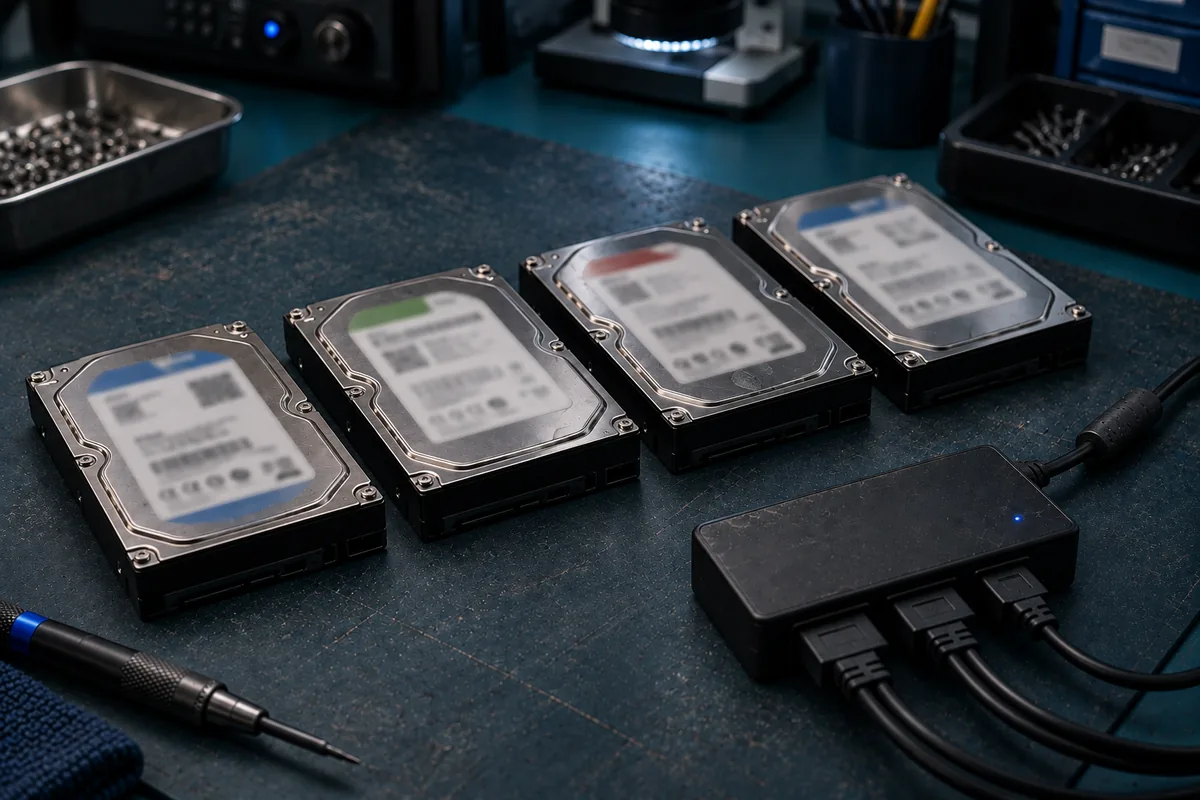
Yes — failed and degraded RAID arrays are usually recoverable, including RAID 5 with two failed disks and arrays where a rebuild failed. We reconstruct the array from the member disks in our lab, often without the original controller. The single most important thing: do NOT force a rebuild, re-initialise, or run repair tools — that's what turns a recoverable array into a lost one. Emergency service and NDAs available.
When your array goes down, downtime is money — act correctly, fast.
RAID exists to protect against a single disk failure — but it's not a backup, and it fails in ways that panic even experienced IT teams: a second disk drops during a rebuild, a controller dies, a volume goes offline, or a rebuild completes onto the wrong data. When that happens, business-critical files, databases and virtual machines are suddenly inaccessible.
CBL has reconstructed thousands of arrays across every RAID level and controller — hardware and software RAID, on servers and NAS units alike. We work from the member disks, rebuild the parity and stripe order, and extract your data safely. For downtime-critical systems we offer emergency and priority service, with NDAs and proper invoicing for businesses.
Do not rebuild, re-initialise, swap disks in a different order, or run CHKDSK/fsck. If a disk failed, power the array down and label the disk order. One wrong rebuild can permanently overwrite recoverable data. Call us first.
RAID levels & recoverability
Select your RAID level to understand its fault tolerance and how we recover it.
RAID 0 — striping, no redundancy
⚠ Tolerates 0 disk failures
Data is striped across all disks for speed, with no redundancy. If one disk fails, the array is down — but the data is usually still recoverable. We image each disk and reconstruct the stripe set. Do not re-create the array.
RAID 1 — mirroring
✓ Tolerates 1 disk failure
Two disks hold identical copies. If one fails, the other still has your data; if both fail or the mirror corrupts, we recover from the healthiest member. Common in small servers and NAS.
RAID 5 — striping with single parity
✓ Tolerates 1 disk failure
Data and parity are distributed across all disks. RAID 5 survives one failure — but if a second disk fails (common during a rebuild), the array goes offline. This is highly recoverable in our lab by reconstructing the parity and disk order — but only if you haven't forced a rebuild. RAID 5 failure recovery →
RAID 6 — striping with double parity
✓ Tolerates 2 disk failures
Two parity blocks allow the array to survive two simultaneous failures. When a third fails, or the array otherwise goes offline, we reconstruct it from the members.
RAID 10 — mirrored stripes
✓ Tolerates 1+ failures (depends on which)
Combines mirroring and striping. It survives one failure per mirror set; lose both disks in a mirror and the array drops. We identify the surviving members and reconstruct the nested array.
What NOT to do with a failed RAID
More RAID data is lost to well-meaning recovery attempts than to the original failure. Please avoid these.
Power the array down, label each disk with its slot number, and call us. Preserving the current state gives the highest chance of a full recovery.
Why RAID arrays fail
An array rarely dies from one clean event. It usually fails because a small problem went unnoticed for months, then a second problem arrived while the first was being fixed.
What we actually see in the lab
- Drives from the same batch. Members bought together and written to identically wear out together. A second failure days after the first is normal, not bad luck.
- A second failure during the rebuild. A rebuild reads every sector of every surviving member — the heaviest load the array will ever see. Marginal drives fail exactly then.
- Silent bad blocks. Sectors written years ago and never read back since. Everything looks healthy until a rebuild reaches them and stalls.
- Controller or backplane failure. A dead card orphans the configuration; a failing backplane or cable drops members intermittently, which looks like disk failure but is not.
- A member dropped offline, then re-added. A disk that fell out holds stale data. Re-inserting it after the array has moved on gives the controller two versions of the truth.
- The wrong disk replaced. Under pressure the healthy member gets pulled instead of the failed one. On a RAID 5 that is instantly two members down.
- Power events. An outage or surge mid-write leaves parity that no longer matches the data it protects.
- Accidental re-initialise. "Create new array" or "initialise" chosen at a controller prompt, usually while trying to make a missing volume reappear.
The last one is the most dangerous, because it can overwrite the layout itself. The rest is routine RAID data recovery work, provided the array is powered down before anyone tries to fix it.
Our RAID recovery process
Free diagnosis
We assess each member disk, identify failed drives and the array parameters, and confirm recoverability — at no cost.
Image every disk
We clone each member disk individually first, repairing any physically failed drives in the cleanroom, so the originals are never risked.
Reconstruct the array
We determine the RAID level, stripe size, disk order and parity rotation from the images and virtually rebuild the array — no original controller required.
Extract & verify
We mount the reconstructed volume, extract your files, databases or VMs, and provide a list to verify.
Secure return
Verified data returned on fresh media, confidentially.
See also how professional recovery works →
What we recover — RAID & beyond
| Scenario | Approach | Typical outcome |
|---|---|---|
| RAID 5, single/second disk failure (not rebuilt) | Parity + order reconstruction | High |
| RAID 0 with one dead disk | Repair disk + stripe rebuild | High |
| RAID 6 multi-disk failure | Double-parity reconstruction | High |
| Controller failure | Rebuild without original controller | High |
| Failed rebuild onto stale data | Recover from imaged members | Case-by-case |
We handle Dell PERC, HP Smart Array, LSI/Broadcom, Adaptec, and software RAID (mdadm, LVM, Storage Spaces, ZFS) — plus NAS arrays and server/virtualisation recovery.
Controllers and systems we recover
Most people describe an array by the controller sitting in front of it. Each family writes its own metadata to the member disks, and knowing where that metadata lives — and when to ignore it entirely — is most of the work.
- Dell PERC. LSI-derived, with a DDF-style configuration region at the end of each member. The "foreign configuration found" prompt at boot is where PERC arrays are most often destroyed.
- HP / HPE Smart Array. Proprietary metadata and a delayed parity rotation that generic tools misread — producing a volume that mounts and then hands back corrupt files.
- LSI / Broadcom MegaRAID. The engine inside many OEM cards. Spanned levels such as RAID 50 and 60 must be reassembled span by span, in the right order.
- Adaptec. Its own metadata block, and a parity rotation that changed between card generations — so the layout is proven from the data, never assumed.
- Areca. Much of the volume-set definition lives on the card itself. A dead Areca can leave perfectly healthy members that look unpartitioned.
- Intel RST (fakeRAID). Assembled by the driver, not by a controller. A Windows reinstall, BIOS reset or motherboard swap can orphan the whole set.
- Linux mdadm software RAID. The superblock sits at a different offset depending on metadata version, usually with LVM and ext4 or XFS on top.
- Windows Storage Spaces. Slab-based rather than classic striping. Parity spaces need the pool database read before a single file can be addressed.
If a controller offers to import, clear or initialise a foreign configuration, choose nothing and power the system down. That prompt is a fork in the road, and one branch overwrites the array layout.
We also see ZFS, Btrfs and vendor variants such as Synology SHR — covered on our NAS data recovery and server recovery pages. If your controller is not listed, tell us the model anyway; the reconstruction comes from the disks either way.
RAID data recovery, array rebuild, degraded array — what people actually mean
People arrive here typing "RAID data recovery", "raid recovery singapore", "RAID 5 recovery", or simply "my server won't boot". The words differ. The confusion behind them is usually one of the four below.
Degraded, failed, offline
A degraded array is still running with a member missing — your data is live, but there is no protection left. A failed array has lost more members than its level tolerates and will not present a volume at all. Offline usually means the controller can see the disks but refuses to assemble them, often because the metadata on the members disagrees. Degraded is the moment to get a copy of the data off while the volume is still stable — or, if a second member is already throwing errors, to power the system down and call us. It is never the moment to experiment.
A rebuild is not a recovery
A rebuild is the controller regenerating a replacement member from parity. A recovery is a lab reconstructing your data from images of the members. They are opposites: a rebuild writes, a recovery only reads. That is why starting a rebuild onto a member that is itself failing goes so badly: the controller overwrites good parity as it goes, then stops halfway when the weak drive gives out.
Hardware RAID, software RAID, fakeRAID
Hardware RAID runs on a dedicated controller with its own processor and cache. Software RAID — mdadm, Storage Spaces, and most NAS data recovery cases — is assembled by the operating system. FakeRAID, such as Intel RST, is a driver pretending to be a controller. All three are recoverable. They simply keep their layout in different places, which is why we identify the type before touching anything.
RAID is redundancy, not backup
RAID protects against a disk dying. It does nothing about deletion, ransomware, a corrupted file system, fire or theft — every member sees those instantly and faithfully. If the array is your only copy, you do not have a backup.
How much does RAID recovery cost?
RAID recovery is complex, multi-disk work; cost reflects the number of disks and failure severity.
| Case type | Examples | Indicative range (SGD) |
|---|---|---|
| Logical RAID | Config lost, controller failure, no physical damage | $1,200 – $2,200 |
| RAID + failed disk(s) | One or more disks need cleanroom repair | $1,800 – $3,500 |
| Complex / emergency | Large arrays, VMs, priority turnaround | $3,000+ |
Exact fixed price before work begins. Full detail: data recovery cost guide →
RAID recovery case studies
Representative examples from typical laboratory cases. Anonymised.
RAID 5 server, failed rebuild
A case-management server lost a second disk mid-rebuild. We imaged all members, reconstructed the parity and disk order, and delivered verified case files under NDA within the priority window.
✓ Full recoveryRAID 6 array offline after power surge
A power surge corrupted the array metadata on a 6-disk RAID 6. We rebuilt the double-parity set from images and restored the shared database.
✓ 99% recoveredRAID 0 editing array, one dead disk
A dead disk took down a 4-disk RAID 0 of active video projects. We cleanroom-repaired the failed disk and reconstructed the stripe set.
✓ Projects recoveredCBL vs a reseller vs DIY software
Three ways a failed array usually gets handled — and what each one actually does to your disks.
| What matters | CBL (in-house lab) | Typical reseller | DIY software |
|---|---|---|---|
| All members imaged before reconstruction | ✓ Every disk | Varies | ✗ Reads the live array |
| Array parameters derived from the images | ✓ Not the originals | Often guessed | ✗ Assumes defaults |
| Original disks kept read-only | ✓ No rebuild attempted | Sometimes rebuilds | ✗ Writes to them |
| Proprietary controller metadata (PERC, Smart Array, MegaRAID) | ✓ Handled in-house | ✗ Outsourced | ✗ Ignored |
| Cleanroom repair of a failed member | ✓ In Singapore | ✗ Sent away | ✗ None |
| Fixed written quote before work | ✓ Always | Varies | n/a |
| Best for | Any failed or degraded array | Simple single-disk swaps | Nothing on a live array |
Emergency diagnosis & a fixed written quote
Free Diagnosis
We assess your array and confirm recoverability — no cost, no obligation.
Emergency Service
Priority turnaround for downtime-critical business systems.
NDA & Confidential
Business-grade confidentiality, NDAs and proper invoicing.
RAID recovery FAQ
Can you recover a failed RAID array?+
Can you recover RAID 5 with two failed disks?+
Should I rebuild the array myself?+
Do you need the original RAID controller or enclosure?+
Do you recover NAS and server RAID too?+
How much does RAID recovery cost?+
Do you offer emergency / 24-7 RAID recovery?+
What happens to the bill if the array cannot be rebuilt?+
My array is degraded but still working — should I let it rebuild?+
Do you recover software RAID and Intel RST fakeRAID?+
The bottom line
A failed RAID array is recoverable far more often than people fear — but only if the first response is right. Power it down, don't rebuild, label the disks, and call CBL. With full RAID-level and controller capability, emergency service, NDAs, we give your array its best chance.
What we do — and what we don’t
CBL Data Recovery (S) Pte Ltd (UEN 201101007Z) is the service provider — not a reseller, referral service or agent. We are a data recovery laboratory. You bring or ship your storage device to our own lab at 6 Harper Road, Leong Huat Building #05-02, beside Tai Seng MRT. Our own engineers image the media in our in-house cleanroom and return your recovered files.
We do not provide remote access or remote sessions, telephone troubleshooting, virus or malware removal, password resets, account recovery, software installation, or device repair, and we sell no software or subscriptions. Any physical work on your media is carried out solely to bring it to a readable state so it can be imaged — you receive your recovered files, not a repaired device.
We do not bypass encryption or account security. Where a device is encrypted, recovery requires the owner’s own password or key. Diagnosis is free, and all work is quoted in writing before it begins.