
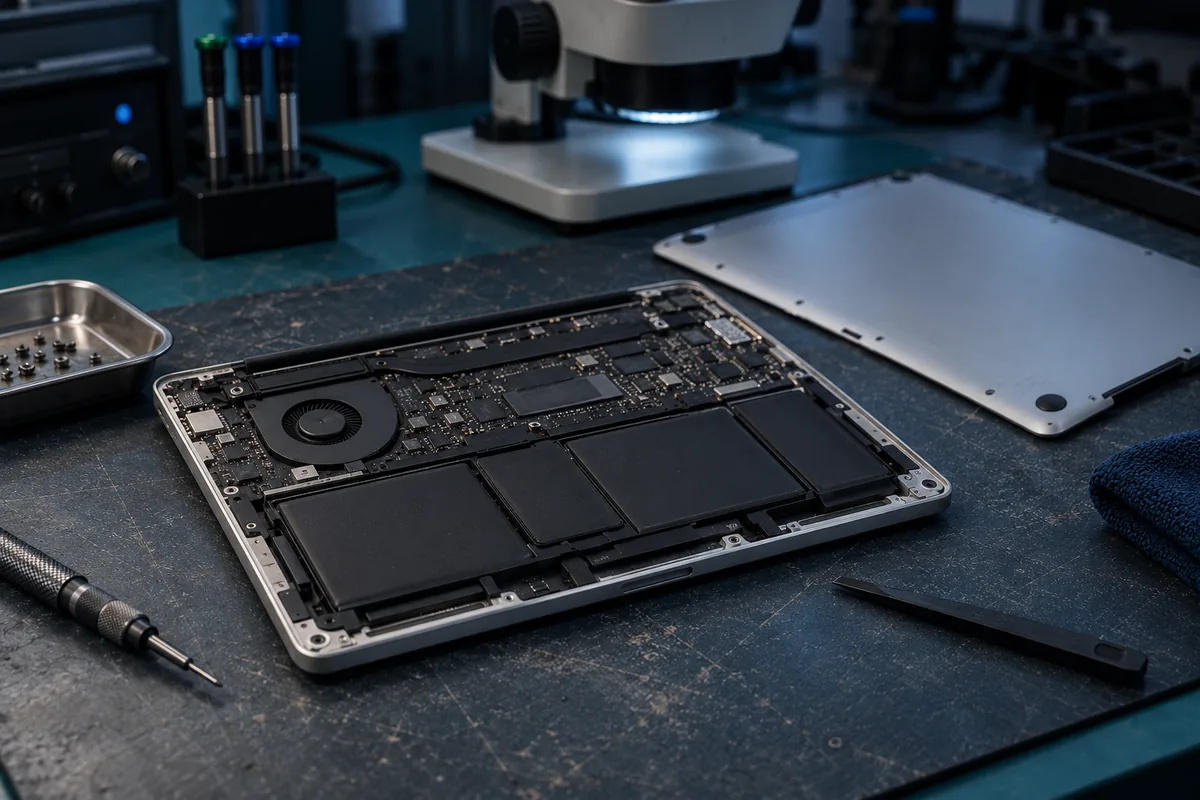
Yes — most Mac data loss is recoverable, from dead MacBooks and failed iMac drives to Fusion and APFS volumes. Newer Macs (T2 and Apple Silicon) encrypt storage by default, so those recoveries generally need your macOS password or FileVault key — with it, we recover the failed hardware and decrypt; without it, strong encryption usually can't be bypassed. We'll tell you honestly at the free diagnosis.
Mac recovery takes Apple-specific expertise — and honesty.
Apple's storage has evolved through several very different systems — removable SATA drives, Fusion Drives, the T2 security chip, and now fully soldered Apple Silicon NAND. Each requires a different recovery approach, and generic tools frequently fail on Macs. Worse, some providers over-promise on encrypted recovery.
CBL has recovered data from every Mac generation — including board-level and NAND work on soldered storage. Just as importantly, we give you a straight answer about what's possible for your specific model, rather than taking a Mac we can't help.
Power it off and don't try to charge or boot it. On soldered Macs the storage is on the logic board — liquid and short circuits threaten the data itself. Book a free diagnosis.
What kind of Mac storage do you have?
Select your Mac type for how recoverable it is — and whether a password is needed.
Intel Mac with a standard drive — high recoverability
Older MacBooks, iMacs and Mac minis with a removable SATA/PCIe SSD or HDD. We recover these with standard cleanroom and imaging methods, reconstructing the APFS or HFS+ filesystem. If FileVault was on, we'll need your password.
Fusion Drive — SSD + HDD paired — high recoverability
Fusion pairs a small SSD with a larger HDD as one logical volume. When one half fails, the volume becomes inaccessible. We recover both devices and rebuild the Fusion/APFS logical structure to extract your data.
T2 Mac (2018–2020 Intel) — encrypted by default
The T2 chip encrypts the SSD automatically, even if you never enabled FileVault. If the Mac's hardware failed but you have your login password, we can often recover and decrypt. Without the password, the encryption generally can't be bypassed — we'll be honest about this.
Apple Silicon (M1/M2/M3) — soldered & encrypted
Storage is soldered to the logic board and encrypted by the Secure Enclave. We perform board-level and NAND-level work to access the storage, but decryption requires your macOS password. Feasibility is assessed individually at diagnosis.
The encryption truth (why we're honest about newer Macs)
If a company promises to recover any T2 or Apple Silicon Mac without your password, be cautious. What we can reliably help with:
- Any Intel Mac with a removable drive (unencrypted) — standard recovery
- Fusion Drives — split reconstruction of the SSD + HDD
- T2 / Apple Silicon Macs where you have the login password / FileVault key — recover then decrypt
- Liquid- or drop-damaged Macs — board-level work to reach the storage
Where odds drop sharply: a T2 or Apple Silicon Mac whose password is genuinely lost. Related: encrypted drive recovery.
Mac data recovery, MacBook data recovery, iMac — what people actually mean
People describe this problem in a dozen different ways. The wording matters far less than one thing: whether the storage can be removed from your Mac at all.
"Mac data recovery"
The umbrella term. It covers every Apple machine — MacBook Air, MacBook Pro, iMac, Mac mini and Mac Studio — and every file system Apple has shipped, from HFS+ through Core Storage to APFS. Two Macs with identical symptoms can still need completely different work in the lab, because Apple changed how the storage is attached.
"MacBook data recovery"
The laptops, typed into Google just as often as macbook recovery singapore. What decides the job is not the year on the box but whether Apple soldered the storage down. On the 2013–2015 MacBook Air and Pro, the 2017 Air, and the 13-inch 2016–2017 Pro without a Touch Bar, the SSD is a removable blade: we lift it out, image it on the bench, and rebuild the file system from that image — the same discipline we apply to any other drive. On the Touch Bar MacBook Pro (2016–2017) and the 12-inch MacBook the NAND is soldered instead, so the work moves to board and chip level, though the data itself is not encrypted unless you switched FileVault on. On any 2018-onwards T2 model or M1 to M4 Apple Silicon MacBook it is both soldered and encrypted, and getting readable files out depends on your macOS password.
"iMac data recovery", "Mac mini", "Mac Studio"
The desktops. Older iMacs frequently hold a Fusion Drive — a small SSD paired with a large hard disk as one logical volume — which is why an iMac can fail in a way no single drive ever would. Mac mini and Mac Studio follow the same split: Intel models with removable storage, Apple Silicon models with soldered, encrypted NAND.
Not the phrase you searched for. Two things: whether the storage is removable, and whether you still have the macOS password or FileVault recovery key.
Macs we recover
The storage type sets the method — and the honest ceiling on what is possible.
| Mac family | Storage | What that means in the lab | Outlook |
|---|---|---|---|
| MacBook Air / Pro (M1, M2, M3, M4) | Soldered NAND, encrypted by the Secure Enclave | Board- and NAND-level access. Your macOS password is required to decrypt. | Case-by-case |
| MacBook Pro / Air 2018–2020 (Intel + T2) | Soldered NAND, encrypted by the T2 by default | Same board-level route. The password is needed even if you never switched FileVault on. | Case-by-case |
| MacBook Pro with Touch Bar 2016–2017, 12-inch MacBook | Soldered NAND, no T2 — encrypted only if you turned FileVault on | Board- and chip-level access. No password needed unless FileVault was enabled. | Case-by-case |
| MacBook Air 2013–2017, MacBook Pro 2013–2015, 13-inch Pro 2016–2017 without Touch Bar | Removable blade SSD | Lifted out and imaged on the bench, then APFS or HFS+ rebuilt from the image. | High |
| MacBook / iMac / Mac mini, pre-2013 | Removable SATA SSD or mechanical hard disk | Standard imaging, with cleanroom work if the mechanism itself has failed. | High |
| iMac with a Fusion Drive | Small SSD paired with a large HDD as one volume | Both halves recovered separately, then the Fusion and APFS structure rebuilt. | High |
| iMac (Apple Silicon), Mac mini M1/M2, Mac Studio | Soldered NAND, Secure Enclave | Board-level access in our Singapore lab; password required. | Case-by-case |
Where we stop, plainly: on a T2 or Apple Silicon Mac the encryption keys live in the Secure Enclave on that specific logic board. If the board is damaged past the point where those keys can be used, and the password is gone with it, the data is gone — not only for us, for anyone. We would rather tell you that at the free diagnosis than bill you to find out. Every one of these jobs is done in-house at 6 Harper Road, beside Tai Seng MRT; nothing is shipped overseas.
Common Mac data-loss scenarios
Mac storage rarely gives notice before it goes. These are the cases that reach our bench most weeks.
What people actually tell us at the counter
- "I emptied the Trash." On APFS the entries vanish at once, but the underlying blocks often survive until macOS reuses them. Stop writing to the disk and the odds stay reasonable — see deleted file recovery.
- "I had Time Machine, though." The backup disk was unplugged months ago, ran out of space, or was quietly failing. A backup nobody has checked is not a backup.
- "The macOS update failed." The Mac restarts into a progress bar that never finishes, or boots to a clean, empty desktop with the old account nowhere to be found.
- "The APFS container won't mount." The disk is healthy enough to be recognised, but the container or volume map is damaged, so nothing appears in Finder.
- "Disk Utility can see it but can't mount it." Greyed-out volume names, disk-management errors, or a First Aid pass that spins for hours and never completes.
- Liquid damage. Coffee, water, a wet bag. On soldered Macs the storage sits on the same board the liquid reached, so corrosion is a race against the clock.
- Drop damage. A fall can shear a connector, crack the logic board, or — on older Macs with a mechanical drive — wreck the heads inside it.
- The FileVault password is forgotten. The hardware can be in perfect condition and the data still unreachable. We will say so plainly rather than take the job.
- Migration Assistant went wrong. A transfer to a new Mac stalled or was interrupted part-way, and files that existed on the old machine now appear on neither.
Our Mac recovery process
Free diagnosis
We identify the Mac model, storage type and fault, and tell you the realistic odds — including any password requirement. No cost.
Hardware access
For removable drives we image directly; for T2/Apple Silicon we perform board-level or NAND-level access to reach the storage.
Decrypt (if applicable)
Where storage is encrypted, we apply your macOS password / FileVault key to decrypt the recovered image.
Reconstruct APFS / Fusion & extract
We rebuild the APFS container or Fusion logical volume and extract your files, then provide a list to verify.
Verify & return
Verified data returned on fresh media.
More on the lab: how professional data recovery works →
What we can recover — by Mac type
| Mac type | Requirement | Typical outcome |
|---|---|---|
| Intel Mac, removable drive (unencrypted) | None | High |
| Fusion Drive | None | High |
| FileVault / T2, password known | Login password | High |
| Apple Silicon, password known | Login password + board work | Case-by-case |
| T2 / Apple Silicon, password lost | — | Generally not possible |
We also recover MacBook SSDs generally — see SSD recovery — and external Mac drives via external drive recovery.
How much does Mac recovery cost?
Cost depends on the model and method — soldered/board-level work is more involved than a removable drive.
| Case type | Examples | Indicative range (SGD) |
|---|---|---|
| Removable drive / logical | Older MacBook/iMac, APFS corruption, Fusion | $250 – $900 |
| T2 / encrypted (password known) | 2018–2020 MacBook, FileVault | $400 – $1,800 |
| Apple Silicon / board-level | M1/M2/M3, liquid/drop damage | $400 – $1,800 |
Exact fixed price before work begins. Full detail: data recovery cost guide →
DIY mistakes that destroy Mac data
Most of the unrecoverable Macs we see were recoverable a week earlier. These six habits are usually what changed that.
Not sleep — shut down, and leave it off until it has been assessed. On a soldered Mac you cannot simply pull the disk out later to undo the damage.
Recovery software is fine on a healthy Mac with a simple deletion and a backup elsewhere. Nothing more. See DIY vs professional recovery →
Mac recovery case studies
Representative examples from typical laboratory cases. Anonymised.
iMac Fusion Drive won't mount
An iMac's Fusion volume became inaccessible after the SSD half failed. We recovered both devices and rebuilt the Fusion/APFS structure to restore the client's design library.
✓ 100% recoveredT2 MacBook Pro, liquid damage
A coffee spill killed a 2019 MacBook Pro. The client had their password; we performed board-level access, imaged the T2 SSD and decrypted it.
✓ Full recoveryM1 MacBook Air, dead board
An M1 Air stopped powering on with a dissertation inside. With the login password, we reached the soldered NAND at board level and recovered the files.
✓ Dissertation savedReal Mac recoveries
From verified 5★ reviews on our Google Business Profile. Names as published on Google.
Urgent MacBook Air recovery in under a day
A MacBook Air failed suddenly and the data was needed urgently. The recovery itself took less than a day, and the machine was collected two days later.
✓ Data recoveredRecovered after Apple said they do not do recovery
A MacBook Pro 16-inch failed after years of use, and Apple service does not do data recovery. Every file was recovered in under two weeks.
✓ 100% recoveredAll the data back before a flight took off
An emergency case with a hard deadline. The team recovered all the data from the MacBook Pro before the owner had to fly.
✓ All data recoveredThese are real reviews from our customers on Google (4.9★ from 909), shown as testimonials.
Free diagnosis & a fixed written quote
Free Diagnosis
Honest assessment of your Mac — no cost, no obligation.
Work Stays In-House
Recovered in our in-house Singapore lab — never shipped overseas.
Secure & Confidential
Your password and data handled securely, PDPA-aware.
Mac recovery FAQ
Can you recover data from a dead MacBook?+
Do you need my Mac password?+
Can you recover a soldered MacBook (M1/M2/M3) SSD?+
Can you bypass the T2 chip or FileVault without a password?+
Is MacBook data recovery different from iMac data recovery?+
What is a Fusion Drive and can you recover it?+
My MacBook had liquid damage — is it recoverable?+
How much does Mac data recovery cost?+
Is CBL cheaper than Apple for data recovery?+
If you cannot recover my Mac's data, is there a charge?+
A failed laptop put important files at risk. The team restored all of the data, with Sarah attentive to every question throughout — one of many happy Apple-product customers. — S YT ★★★★★ · More real case studies →
The bottom line
Mac recovery rewards Apple-specific expertise and honesty over false promises. CBL recovers every Mac generation — including soldered T2 and Apple Silicon at board level — and gives you a straight answer about what your password allows. With there's no risk in finding out.
What we do — and what we don’t
CBL Data Recovery (S) Pte Ltd (UEN 201101007Z) is the service provider — not a reseller, referral service or agent. We are a data recovery laboratory. You bring or ship your storage device to our own lab at 6 Harper Road, Leong Huat Building #05-02, beside Tai Seng MRT. Our own engineers image the media in our in-house cleanroom and return your recovered files.
We do not provide remote access or remote sessions, telephone troubleshooting, virus or malware removal, password resets, account recovery, software installation, or device repair, and we sell no software or subscriptions. Any physical work on your media is carried out solely to bring it to a readable state so it can be imaged — you receive your recovered files, not a repaired device.
We do not bypass encryption or account security. Where a device is encrypted, recovery requires the owner’s own password or key. Diagnosis is free, and all work is quoted in writing before it begins.