
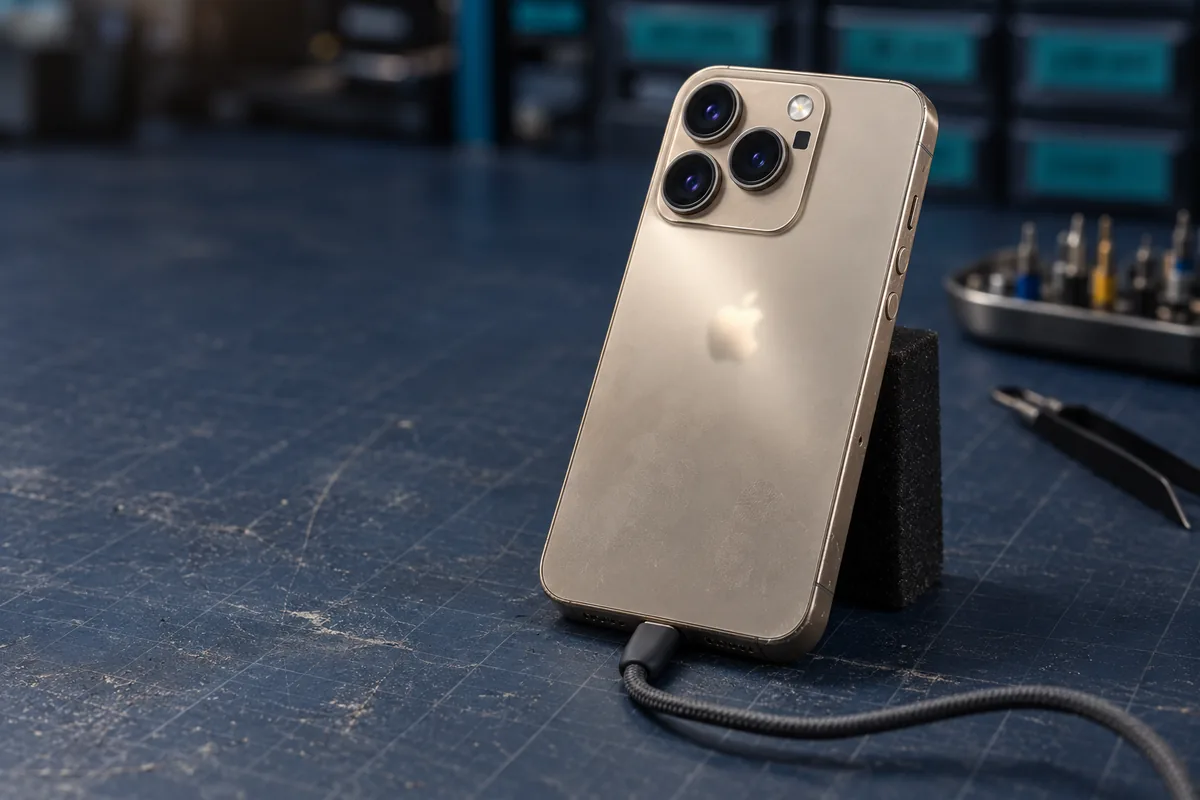
When an iPhone dies from water, a drop, or a board fault, the data is usually still intact — the phone just can't boot to reach it. We repair the logic board (micro-soldering, component-level) in our cleanroom lab so the device powers up long enough to extract your photos, videos, messages and contacts. What we don't do is bypass Apple's security — a passcode-locked, disabled or factory-reset iPhone stays encrypted, and that data can't be recovered by anyone.
How iPhone data recovery works
Modern iPhones store data on NAND flash soldered to the logic board and encrypted by the Secure Enclave. When a phone won't turn on, the storage is typically fine — the problem is power, a damaged component, or corrosion stopping it from booting. Our engineers repair the board — cleaning corrosion, replacing failed power ICs, reworking or transferring components — so the phone boots with your passcode and the data can be copied off normally. It's precision electronics work, done in-house, not a software "hack".
Got the latest model? See our in-depth iPhone 17 Pro & iPhone 17 Pro Max data recovery guide for model-specific detail on Apple-logo boot loops, water damage and what's recoverable on the A19 Pro.
iPhone data is encrypted and tied to your passcode. We need the device to power on and be unlocked with the passcode you know. We can't — and no honest lab can — decrypt a locked iPhone you can't unlock.
CBL is a data recovery laboratory. We work on the logic board because that is how we reach your files, not as a repair service. We don't do screen replacements, battery swaps or general iPhone repair, and we don't hand the phone back as a refurbished device. If your phone still works and you simply want it fixed, a repair centre is the right place. If your data is trapped on a phone that won't boot, that's us.
iPhone data recovery, photo recovery, iCloud recovery — what people actually mean
People describe this in very different ways, and here the words genuinely matter — because two of them are not laboratory jobs at all. If one of the descriptions below matches your situation, it will tell you quickly whether we can help.
“iPhone data recovery” vs “iPhone repair”
A repair shop aims to give you a working phone. We aim to get your data off it. Those are different goals and they lead to different decisions: a repair may involve replacing the logic board, which is exactly the part your data is tied to. If the photos matter more than the handset, say so before anyone opens it.
“Recover deleted photos from iPhone”, “iPhone photo recovery”
If the phone still switches on, check Photos → Albums → Recently Deleted first. Deleted items sit there for 30 days and that costs you nothing. Beyond that window, deleted-file recovery on a working modern iPhone is largely a myth: the storage is encrypted and space is reclaimed aggressively, so the software products promising it usually surface only what was already in a backup. Where we genuinely help is a phone that will not turn on at all.
“iCloud recovery”, “recover my iCloud data”
If the data lived only in iCloud, it is not on the handset, so there is nothing for a laboratory to extract. That is an Apple account problem and is resolved through Apple, not through us. We will tell you so at diagnosis rather than take the job.
“Dead iPhone”, “won't turn on”, “stuck on the Apple logo”
These are the cases built for us. In almost all of them the storage itself is fine and the problem is the board around it — power circuitry, corrosion, or a fault that stops the phone completing boot. Repair the board, and the data is still sitting there.
“Chip-off” on an iPhone
Chip-off works on USB sticks and memory cards, where the flash can be read on its own. It does not translate to an iPhone. Since 2013 every iPhone encrypts its storage against keys held in the Secure Enclave on that specific board, so a NAND chip lifted away from its own logic board reads as noise. That is why iPhone work is board repair, not chip removal.
What can & can't be recovered
✅ Often recoverable
- iPhone that won't turn on / no power
- Water or liquid damage (toilet, pool, sea, drink)
- Stuck on the Apple logo / boot loop
- Dropped phones with board damage
- Won't charge, no display, but you know the passcode
- Photos, videos, messages, contacts, notes, WhatsApp
🛑 Honestly not recoverable
- Passcode-locked / disabled iPhone you can't unlock
- Devices that were factory reset / erased
- Activation Locked phones without the Apple ID
- Data that only ever lived in iCloud, not on the device
- NAND storage that's been physically destroyed (fire, severe crush)
We confirm which case you're in at the free diagnosis — no false hope.
iPhones we recover — and what changes by model
We see every generation still in circulation. The method barely changes; what changes is how tightly the storage is bound to the board it came from.
| Model family | What that means for recovery |
|---|---|
| iPhone 6, 6s, 7, 8, SE | Encrypted, but comparatively forgiving boards to work on. Water and power-circuit faults on these are routine for us. |
| iPhone X, XR, XS | Denser, layered boards and the move to Face ID. Board repair is more delicate, but the approach is unchanged. |
| iPhone 11, 12, 13 | Stacked logic boards. Separating and reworking the layers takes longer, which is usually what drives the quote. |
| iPhone 14, 15 | Tighter integration again. Liquid-damage cases still recover well when they reach us promptly. |
| iPhone 16, 17 | The newest boards and the least margin for error. Assessed case by case at the free diagnosis. |
The constant across all of them is the Secure Enclave. Your data is encrypted against keys that exist only on your phone's own board, and unlocking them needs your passcode. That single fact explains most of what follows: why we repair the board rather than remove the chip, why we ask whether you know the passcode before quoting, and why nobody — ourselves included — can get into a locked iPhone without it.
If your photos matter more than the handset, say so first. Replacing a logic board fixes the phone and loses the data, because the data was tied to the board that was removed.
Common iPhone situations we handle
Those four cover most of what comes through the door, and they share a pattern worth understanding: in each case the storage is generally intact and the fault lies in the board around it. That is the difference between a frightening symptom and an unrecoverable one.
A few others we see regularly:
- Dropped, then worked for a while. A cracked solder joint can take days or weeks to fail completely. The data is usually fine.
- Failed during an iOS update. Alarming, but often a software-state problem rather than physical damage.
- Overheating or a swollen battery. Have it assessed rather than charged — a swollen cell is a physical risk as well as an electrical one.
- Went through the wash, dried out, then “seemed fine”. The most deceptive case of all. Corrosion continues quietly for weeks after the water has gone.
- Damaged charge port or a snapped cable tip inside. Frequently a straightforward case in the lab, with the data untouched.
Real iPhone recoveries
From verified 5★ reviews on our Google Business Profile. Names as published on Google.
Data back after a "motherboard failure" verdict
An iPhone 14 failed suddenly; another shop diagnosed motherboard failure. CBL's engineers worked patiently on the board and recovered all the data the owner feared was lost.
✓ All data recoveredRecovered after auto-shutdown & boot loop
An iPhone 12 Pro shut down suddenly and got stuck at the Apple logo; Apple staff said a reset was the only option. Our team recovered the important data from the failed device.
✓ Data recoveredPhotos & videos off a water-damaged phone
An iPhone X went into water holding important, un-backed-up photos, videos and memories after a usual repairer flagged the motherboard. CBL took on the recovery.
These are real reviews from our customers on Google (4.9★ from 909), shown as testimonials.
CBL vs a phone repair shop vs DIY software
All three are sold as answers to the same problem. They are not equivalent, and the difference matters most when the data is irreplaceable.
| What matters | CBL (in-house lab) | Phone repair shop | DIY software |
|---|---|---|---|
| Goal of the work | ✓ Recover your data | Make the phone usable | Scan a working phone |
| Micro-soldering & board repair | ✓ In-house | Varies widely | ✗ None |
| Works on a phone that will not boot | ✓ Yes | Sometimes | ✗ No |
| Keeps the original logic board | ✓ Always | Often replaced | n/a |
| Liquid-damage decontamination | ✓ Yes | Varies | ✗ |
| Tells you honestly when it cannot be done | ✓ At free diagnosis | Varies | ✗ Sells anyway |
A good repair shop is the right choice when you want the phone working and your data is already backed up. We are the right choice when the data is the point — and we will say so plainly if your case is one a repair shop can handle more cheaply.
If your iPhone just failed
Why these four matter more than they look
Almost every unrecoverable iPhone we see was recoverable at some earlier point. What closed the door was usually well meant.
- Rice does nothing useful. It absorbs a little ambient moisture and none of the liquid inside the phone, while the corrosion it was supposed to stop carries on eating tracks off the board. The delay is the damage.
- Every boot attempt is a risk. Powering a wet or faulty board pushes current through paths that are no longer insulated. One attempt is understandable; twenty is how a repairable fault becomes a burnt one.
- Charging is the worst version of that. It applies the most current for the longest time, and it is the single most common way a liquid-damaged iPhone becomes unrecoverable.
- Do not let anyone replace the logic board before the data is off. It fixes the phone and ends the recovery in the same movement.
And bring the passcode. Without it the encryption cannot be unlocked by anyone, and we would far rather tell you that at the counter than after the work.