
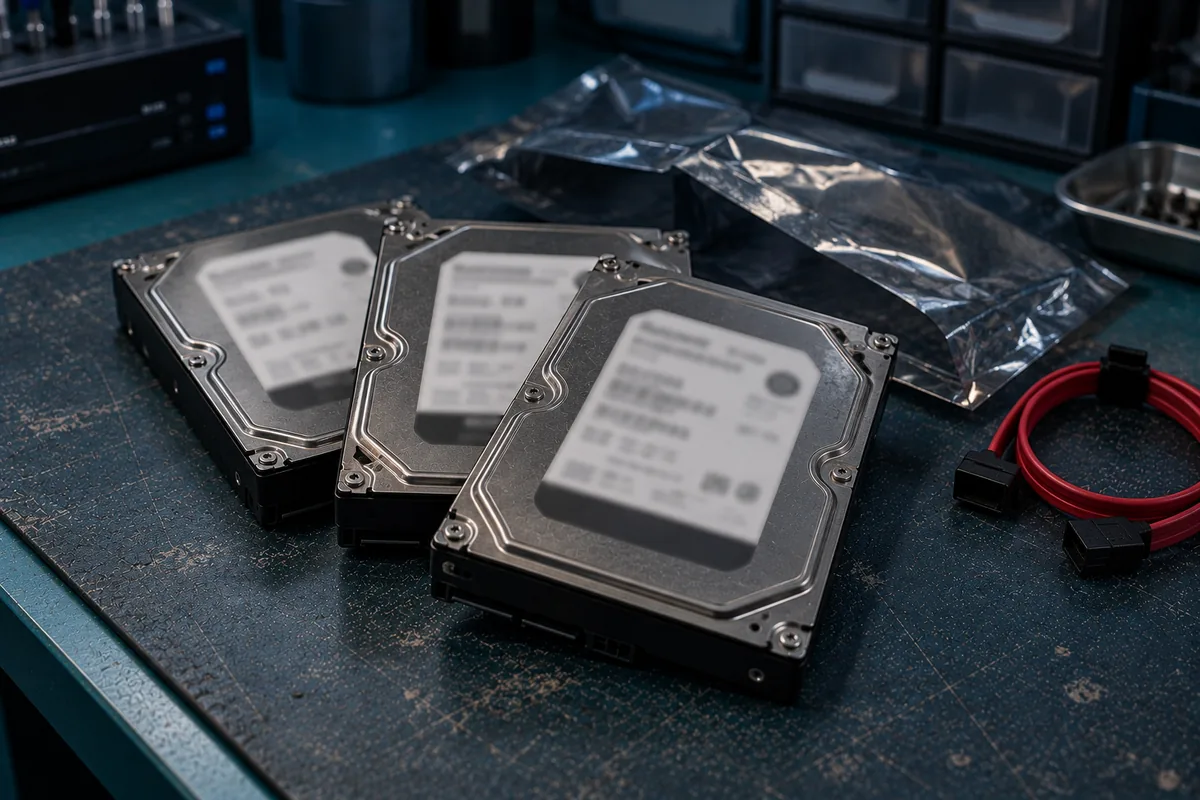
Yes — failed Seagate drives are usually recoverable, including beeping and clicking drives and the firmware faults Seagate is known for. Seagate's F3 firmware architecture and translator corruption need specialist handling, and a beeping drive means stuck heads — a physical fault. Power a beeping or clicking Seagate off immediately and don't keep power-cycling it, then book a free diagnosis.
Seagate fails in Seagate-specific ways.
Seagate is one of the most common brands we recover — and one with well-known failure patterns. Seagate drives use the F3 firmware architecture, where firmware or "translator" corruption can make a physically healthy drive completely inaccessible. Seagate portables are also prone to a distinctive beeping — the sound of read/write heads stuck to the platters, unable to spin up.
CBL handles Seagate's firmware, translator and stuck-head issues in-house, with the tools and donor stock to recover the full Seagate range.
Power it off immediately and don't keep switching it on and off. Beeping and clicking are physical faults; repeated power-ups can scratch the platters. Then book a free diagnosis.
Beeping Seagate? That's stuck heads.
If your Seagate portable makes a repeated beeping sound and doesn't spin up, the read/write heads are stuck to the platter surface and the motor can't turn. This is a physical fault that needs cleanroom recovery — not software. Every attempt to power it on risks damaging the platters further. We free or replace the stuck heads in the cleanroom and recover the data.
Common Seagate failures
What each Seagate symptom is telling you
Seagate drives announce their faults fairly clearly, once you know what the noises mean. Find yours below before you touch anything else.
- A steady beep, roughly once a second, no spin-up. The heads are stuck to the platters and the motor is stalling against them. Physical. Stop powering it.
- Clicking or ticking, a pause, then the same again. The heads cannot find the servo tracks, so the drive keeps recalibrating. A head has failed, or the preamplifier has.
- Spins up normally but never appears in Disk Management. Usually firmware — a corrupt translator or a damaged service-area module. The platters are often untouched, which is why these cases tend to recover well.
- Detected, but capacity reads 0 GB or the model shows as a garbled string such as "ST_M13FQBL". A classic Seagate service-area fault: the drive is talking, but it can no longer map logical sectors to physical ones.
- Mounts, then asks to be formatted, or shows as RAW. File-system damage, not hardware damage. Do not format it. Often the most recoverable category of all, provided nothing writes to the drive.
- Copies for a few minutes, then crawls and freezes. Growing bad sectors, or an SMR drive stalling on its internal rewrites. Every retry adds wear.
- A faint buzz or a rhythmic whine instead of a clean spin-up. Motor or bearing seizure, usually after a knock while running.
If either of the first two describes your drive, it needs a cleanroom, not software. If you cannot tell which category you are in, that is what the free diagnosis is for.
Seagate recovery services in Singapore — your options
If you searched "Seagate Singapore" or "Seagate recovery services" after a drive failed, you have more than one route. Here they are honestly, including the one that isn't us.
Seagate's warranty replaces the hardware. Send a failed drive in and you get a different drive back — the original, and the data on it, is gone. Recover the data first. The warranty claim still stands afterwards.
Seagate's own Rescue service
Seagate offers Rescue Data Recovery Services, bundled with some of its drives (several IronWolf, SkyHawk and external models include a subscription). If your drive came with it, it is a legitimate option and you have already paid for it — check your drive's documentation before paying anyone.
The practical trade-off is logistics: the drive is shipped out of Singapore and turnaround is typically measured in weeks. If the data is time-critical, or you would rather the drive stayed in the country, a local lab is faster.
What we are
CBL is an independent data recovery laboratory. We are not Seagate's authorised service centre and we are not affiliated with Seagate. We recover data from failed Seagate drives — Barracuda, IronWolf, SkyHawk, Exos, FireCuda, and the Backup Plus and Expansion external ranges — in our own in-house cleanroom in Singapore. Free diagnosis.
Seagate data recovery Singapore, Seagate hard drive recovery, Seagate external drive recovery — what people actually mean
People describe this problem in half a dozen ways, and most of the differences do not change the job at all. One of them genuinely does. Here is which is which.
"Seagate data recovery Singapore" and "Seagate hard drive recovery"
The same service. The brand tells us which firmware architecture and which donor parts we need; it does not change the method. Every case follows the same path — diagnose, stabilise, image sector by sector, then rebuild the file system from the image rather than from the failing drive.
"Seagate external drive recovery" — the box is not the drive
A Backup Plus, Expansion or One Touch is an ordinary Seagate mechanism plus a USB bridge board, and that distinction matters. On 2.5in portables the USB connector is usually soldered directly onto the drive's own circuit board, so there is no SATA port to fall back on when the connector or bridge chip fails. On some models the bridge also encrypts everything written through it, so pulling the bare drive out and plugging it into a PC returns unreadable data even though the mechanism is healthy.
"Seagate repair" versus "Seagate recovery"
This is the confusion worth settling. If you want the drive repaired so you can keep using it — honestly, don't. A drive that has failed once has told you what it will do again. What we do is repair it far enough to read it: head, PCB, firmware and motor work are all a means to one end, a clean image. Your files come back on healthy media you keep, and the original Seagate is never trusted with them again.
Not the words you use — the label. Every Seagate carries an ST or ZP model number, a firmware revision and a site code. Those three decide whether a donor will work. Photograph the label before you bring the drive in and we can check stock before you arrive.
If you were searching for a Seagate service centre or a warranty claim rather than recovery, those are different things again — see your options above, and claim the warranty only after the data is off.
Seagate models we recover
What each Seagate family means on the bench
- Barracuda. The mainstream desktop and laptop line, and the drive we see most often. Common enough that matching donors are usually already on our shelf. Several high-capacity Barracuda Compute models are SMR, which changes how we image them.
- FireCuda. Hybrid SSHDs, conventional drives and NVMe SSDs have all carried the name. An SSHD is treated as a hard drive failure; an NVMe fault is a controller and NAND problem, closer to SSD recovery.
- IronWolf and IronWolf Pro. NAS drives, so they rarely arrive alone. The real job is usually rebuilding the array rather than one disk — see NAS recovery.
- SkyHawk. Surveillance drives out of DVRs and NVRs. Years of continuous writing means they arrive with widespread bad sectors and a proprietary recorder file system on top. See CCTV and DVR recovery.
- Exos. Enterprise SATA and SAS drives from servers and arrays. The helium-filled models are sealed: once opened for head work they run on air and stay stable only long enough to image, so there is realistically one clean attempt.
External families
Backup Plus, Expansion, One Touch, Ultra Touch and the older FreeAgent and GoFlex ranges all wrap a standard Seagate mechanism in a USB bridge. Bring the enclosure, its cable and its power supply with the drive — on a portable the USB port is often part of the drive's own PCB, and on desktop units the power adapter is a common culprit in its own right.
SMR: why some Seagate drives image slowly
Shingled magnetic recording writes tracks that overlap like roof tiles, so writing one disturbs its neighbours and the drive must rewrite whole bands in the background. Imaging is therefore slower — the drive stalls while it finishes housekeeping it began before you brought it in — and a drive that lost power mid-reorganisation can hold data in its media cache that never reached its final home.
Certain Seagate external bridge boards encrypt everything written through them, whether or not you ever set a password. Remove the bare drive and connect it to a SATA port and you may get nothing readable. Keep the enclosure with its drive and let us separate them properly.
Our Seagate recovery process
Free diagnosis
We identify the fault — stuck heads, firmware/translator, PCB or heads — and confirm recoverability. No cost.
Cleanroom / firmware repair
We free or replace stuck/failed heads in the cleanroom, or repair the F3 firmware and translator.
Image & reconstruct
We clone the drive, then rebuild the file system and extract your files.
Verify & return
Verified data returned on fresh media.
See the general process: hard drive recovery.
How much does Seagate recovery cost?
| Case type | Examples | Indicative range (SGD) |
|---|---|---|
| Logical | Corruption, RAW, deleted files | $180 – $650 |
| Firmware / PCB | Not detected, F3 translator fault | $300 – $900 |
| Physical (beeping/clicking) | Stuck or failed heads, cleanroom | $400 – $1,800 |
Exact fixed price before work begins. Full detail: data recovery cost guide →
DIY mistakes that destroy Seagate drives
Most of the unrecoverable Seagate drives that reach us were recoverable a week earlier. These are the usual reasons, and the mechanism behind each one.
Two more are worth naming. CHKDSK on a failing Seagate rewrites file-system structures using a drive that can no longer write reliably, turning a clean logical case into a partial one. And the freezer trick is a myth — condensation and thermal shock damage platters and heads, and it has never freed a stuck head-stack.
DIY software has one honest use: a healthy drive, a simple deletion, a backup elsewhere. See DIY vs professional recovery →
Seagate recovery case studies
Representative examples from typical laboratory cases. Anonymised.
Clicking Seagate — 12 years of photos
A 2TB Seagate started clicking mid-backup. We fitted a matched donor head-stack in the cleanroom, imaged the platters and rebuilt the file system.
✓ 99% recoveredBeeping Backup Plus — stuck heads
A Seagate Backup Plus beeped and wouldn't spin up. We freed the stuck heads in the cleanroom and recovered the client's files.
✓ Fully recoveredBarracuda F3 firmware fault
A Barracuda became inaccessible from a translator fault. We repaired the F3 firmware and extracted the data.
✓ Data recoveredCBL vs a reseller vs DIY software
For Seagate work three things decide the outcome: whether the lab repairs F3 firmware itself, whether it holds matching donor mechanisms, and whether your drive leaves the country.
| What matters | CBL (in-house lab) | Typical reseller | DIY software |
|---|---|---|---|
| F3 firmware & translator repair | ✓ In-house | Sent elsewhere | ✗ None |
| Cleanroom work on a beeping drive | ✓ On-site | ✗ Outsourced | ✗ None |
| Matching Seagate donor stock | ✓ Held here | Varies | ✗ |
| Encrypting external bridge handled | ✓ Bridge kept with drive | Varies | ✗ |
| Drive stays in Singapore | ✓ Always | Often shipped out | Not applicable |
| Best for | Any Seagate failure | Simple cases | Minor logical + backup exists |
Free diagnosis & a fixed written quote
Free Diagnosis
We assess your Seagate drive — no cost, no obligation.
Work Stays In-House
Recovered in our in-house Singapore lab — never shipped overseas.
Fixed Quote First
A firm written price before any work begins. No hidden fees.
Seagate recovery FAQ
Is CBL an authorised Seagate service centre?+
What does Seagate recovery cost compared with a warranty replacement?+
My Seagate is beeping — what's wrong?+
Why do Seagate drives fail firmware?+
Can you recover a clicking Seagate?+
Do you recover Backup Plus and Expansion drives?+
Can you recover Seagate SMR drives?+
How much does Seagate recovery cost?+
What if the Seagate drive turns out to be unrecoverable?+
Why do you ask for the model number on my Seagate label?+
My Seagate external drive is not recognised — is it the drive or the enclosure?+
Is my Seagate external drive encrypted?+
Why does an SMR Seagate drive take longer to recover?+
The bottom line
Seagate drives fail in recognisable ways — beeping stuck heads, F3 firmware faults, clicking — and each needs the right specialist approach. Power a beeping or clicking Seagate off, don't power-cycle it, and let CBL diagnose it free. There's no risk in finding out.