
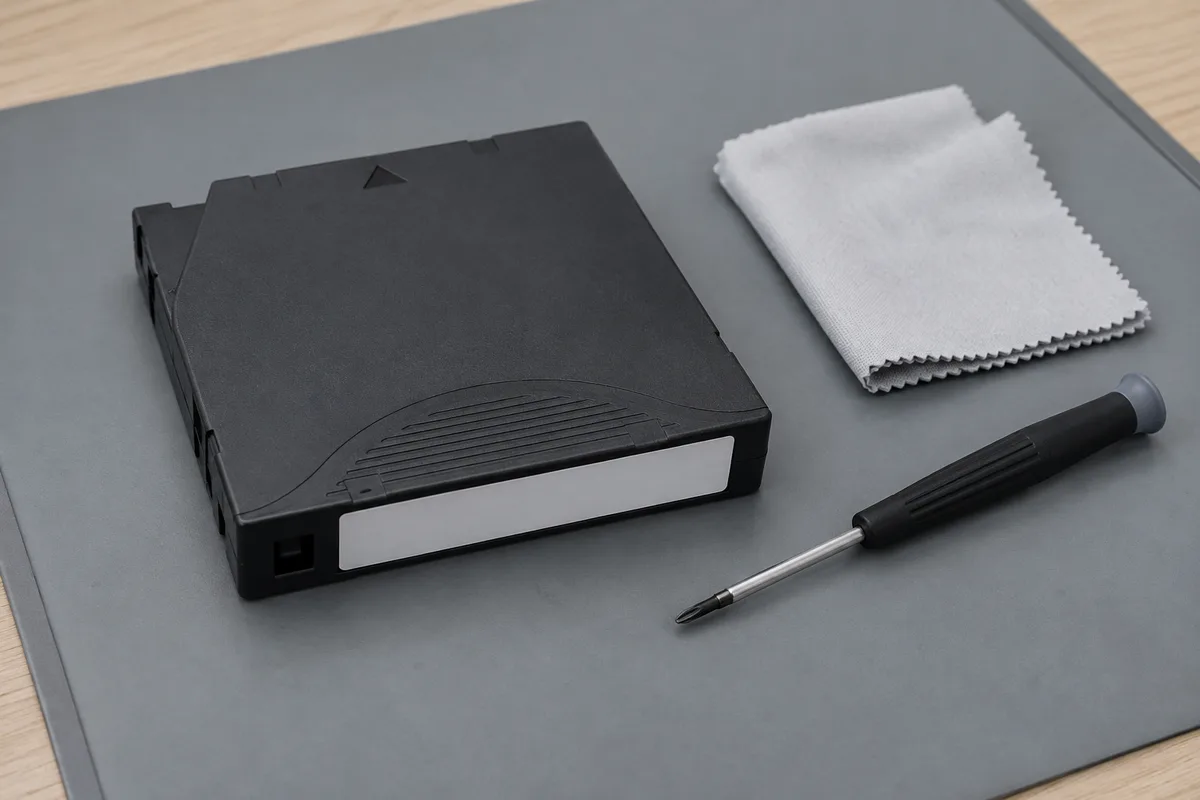
Tape is usually the last copy. That is exactly when it stops reading.
Tape data recovery in Singapore almost always starts the same way: someone goes to restore an archive nobody has touched in years, and the drive spits the cartridge back out. Tape is the copy of last resort — which means a tape that will not read is usually the only thing standing between a business and permanent loss.
The good news is that tape is mechanically simple and physically robust. A cartridge that will not mount is far more often a damaged leader, a seized reel, a degraded binder layer or a drive fault than it is destroyed data. The magnetic layer itself survives a great deal.
We recover from LTO (Ultrium), DAT and DDS, DLT and SDLT, AIT, Travan and older reel formats, including cartridges written by backup software nobody in the building still runs.
What NOT to do with a tape that will not read
Do not keep re-inserting it. Every load attempt drags the tape across the heads and past the leader mechanism. If the leader pin has detached or the tape has a fold, each retry turns a clean repair into a shredded one.
Do not open the cartridge. The shell keeps dust off the media and holds the reel under controlled tension. Opened outside a clean environment, a tape picks up particles that behave like sandpaper at read speed.
Do not try a different drive "just to check". If a drive is chewing tape, the second drive will chew it further — and a drive damaged by a bad cartridge will then damage the next good one you put in it.
Do not let it dry out or warm up after water exposure. Keep it sealed and bring it in. As with drives, it is the corrosion and the drying, not the water itself, that does the lasting harm.
Why tapes fail here in particular
Singapore is a hard place to store tape. Year-round humidity around 80% is the single biggest factor we see, and it attacks tape in a way it does not attack a sealed hard drive.
- Binder hydrolysis. The layer bonding the magnetic particles to the backing absorbs moisture over years and turns tacky. The tape then squeals, sheds and sticks to the heads. This is the classic failure of older cartridges stored in an uncooled room, and it is often recoverable with the right handling.
- Mould. A cartridge left in a cupboard through enough monsoon seasons can grow visible mould between the wraps. It must be dealt with before the tape is ever spun, or the growth is ground into the surface.
- Leader pin detachment. On LTO the drive grabs a small pin at the end of the tape. Adhesive ages, the pin comes away, and the drive reports the cartridge as faulty without ever reading a byte. This is a mechanical repair, not data damage.
- Snapped or folded tape. A jam, a power loss mid-write, or a worn drive can crease or part the tape. The media either side of the break is usually intact.
- The drive died, not the tape. Frequently the cartridge is fine and the hardware that wrote it is the problem — heads, motors or firmware.
- Nothing can read it any more. Each LTO generation reads only a generation or two back, so an archive routinely outlives every drive in the building that could mount it.
Formats and backup software we handle
Reading the tape is only half a tape recovery. The other half is making sense of what the backup application wrote onto it.
Formats: LTO / Ultrium across generations, DAT and DDS, DLT and SDLT, AIT, Travan, QIC, and older open-reel media.
A tape written by enterprise backup software is not a folder of files. It is a stream in that application's own container, indexed by a catalogue that usually lives on a server which may itself be long gone. Recovering the data means reconstructing that structure without the catalogue — cartridges written by Veritas NetBackup and Backup Exec, Veeam, Arcserve, IBM Spectrum Protect (Tivoli), Bacula, Amanda and the various native tar and dump formats all behave differently here.
That is the part people underestimate. A tape can read perfectly and still be useless until the container is parsed correctly.
How a tape case runs
- 1. Free diagnosis. We inspect the cartridge, identify the format and determine whether the fault is mechanical, chemical or in the data itself.
- 2. Fixed written quote. You get the likely procedure and the price before any work begins. You decide.
- 3. Stabilise the cartridge. Leader repair, re-spooling, cleaning or controlled treatment of a degraded binder — whatever the tape needs in order to be read once, safely.
- 4. Image the tape. We read to an image rather than working the original repeatedly. Every later attempt happens against the image.
- 5. Rebuild the file structure. The backup container is parsed and the files extracted, with or without the original catalogue.
- 6. Return on usable media. You receive the data on media you can actually use, with a file listing to check against.
What tape recovery costs
Tape pricing follows the same rule as the rest of our work: diagnosis is free, the quote is fixed and written, and if we cannot recover your data you do not pay our recovery fee.
What moves the price is the failure type, not the capacity. A detached leader pin on an otherwise healthy LTO cartridge is a straightforward mechanical repair. A mould-affected tape needing treatment before it can be spun, or a multi-cartridge set with no surviving catalogue, is considerably more work. We will tell you which one you have before you commit to anything.
See data recovery pricing for how our quotes are structured.
Free diagnosis & a fixed written quote
Bring the cartridge to 6 Harper Road #05-02, beside Tai Seng MRT, or send us the details first if you would rather talk it through. If the tape is wet or visibly mouldy, seal it in a bag and do not attempt to clean or dry it yourself.
With 20+ years and 140,000+ recoveries behind us, most of what arrives here is something we have seen before — including formats that stopped being sold a decade ago.
Tape recovery FAQ
The tape is visibly mouldy. Is it finished?
Usually not. Mould sits between the wraps and on the surface; the magnetic layer beneath is
often intact. It must be treated before the tape is spun, which is exactly why you should
not test it in a drive first.
We no longer own a drive that can read these cartridges.
That is one of the more common reasons people call. You do not need a working drive for us
to recover the data — bring the tapes.
The backup server is gone, so we have no catalogue.
The catalogue helps but is not essential. The structure can be rebuilt from what is written
on the tape itself; it is more work, and the quote reflects that.
Our tape squeals and the drive ejects it.
That is the signature of a degraded binder layer absorbing humidity over years. Stop using
it. Each attempt sheds more of the magnetic surface onto the heads.
Can you recover a tape the drive has chewed?
Often, yes. Damage is usually confined to a section, and the tape either side of it is
readable. Do not attempt to wind it back in by hand.
Do you sell tape drives, libraries or backup systems?
No. We are a data recovery laboratory — we recover data from media that has already
failed. If you are looking to buy tape storage, you want a hardware vendor rather than us.
What we do — and what we don't
We do: recover data from LTO, DAT, DDS, DLT, SDLT, AIT, Travan and older reel tape, including mechanical repair of the cartridge, treatment of humidity-damaged media, imaging, and rebuilding the file structure written by enterprise backup software.
We do not: sell tape drives, tape libraries, autoloaders or backup software, and we do not provide managed backup services. We are a recovery laboratory. If your tapes are healthy and you need somewhere to buy hardware, a storage vendor is the right call — not us.