
Deleting a single file is one thing — deleting an entire folder full of documents, photos, or a whole project is a special kind of panic. On a Mac, though, a deleted folder is very often recoverable, and there are three reliable ways to get it back, plus a fallback for when those don't apply. This guide covers the top 3 ways to recover a deleted files folder on Mac in 2026, in order of ease, so you can get your data back with the least fuss.
From the engineers at CBL Data Recovery Singapore — because a deleted folder isn't always a lost one.
The golden rule first
Before the methods, one crucial habit: the moment you realise a folder is missing, stop using the Mac heavily. A deleted folder's data stays on the drive until overwritten, so the less you save, install, or download, the better your chances — especially if you'll need recovery software. On Apple Silicon Macs, the internal SSD's TRIM erases deleted data quickly, so speed matters even more. With that in mind, here are the top 3 ways.

Way 1: The Trash (and Put Back)
The fastest fix, and the one people overlook in a panic. Open the Trash from the Dock. If your deleted folder is there, right-click it and choose Put Back to return it — and all its contents — to its original location, or drag it out to wherever you want it. Unless you've emptied the Trash, your folder is one click from full recovery. This solves the majority of "I deleted a folder" cases in seconds.
Way 2: Time Machine
If you have a Time Machine backup, this is the most reliable recovery — and it works even after the Trash was emptied:
- Connect your Time Machine backup drive.
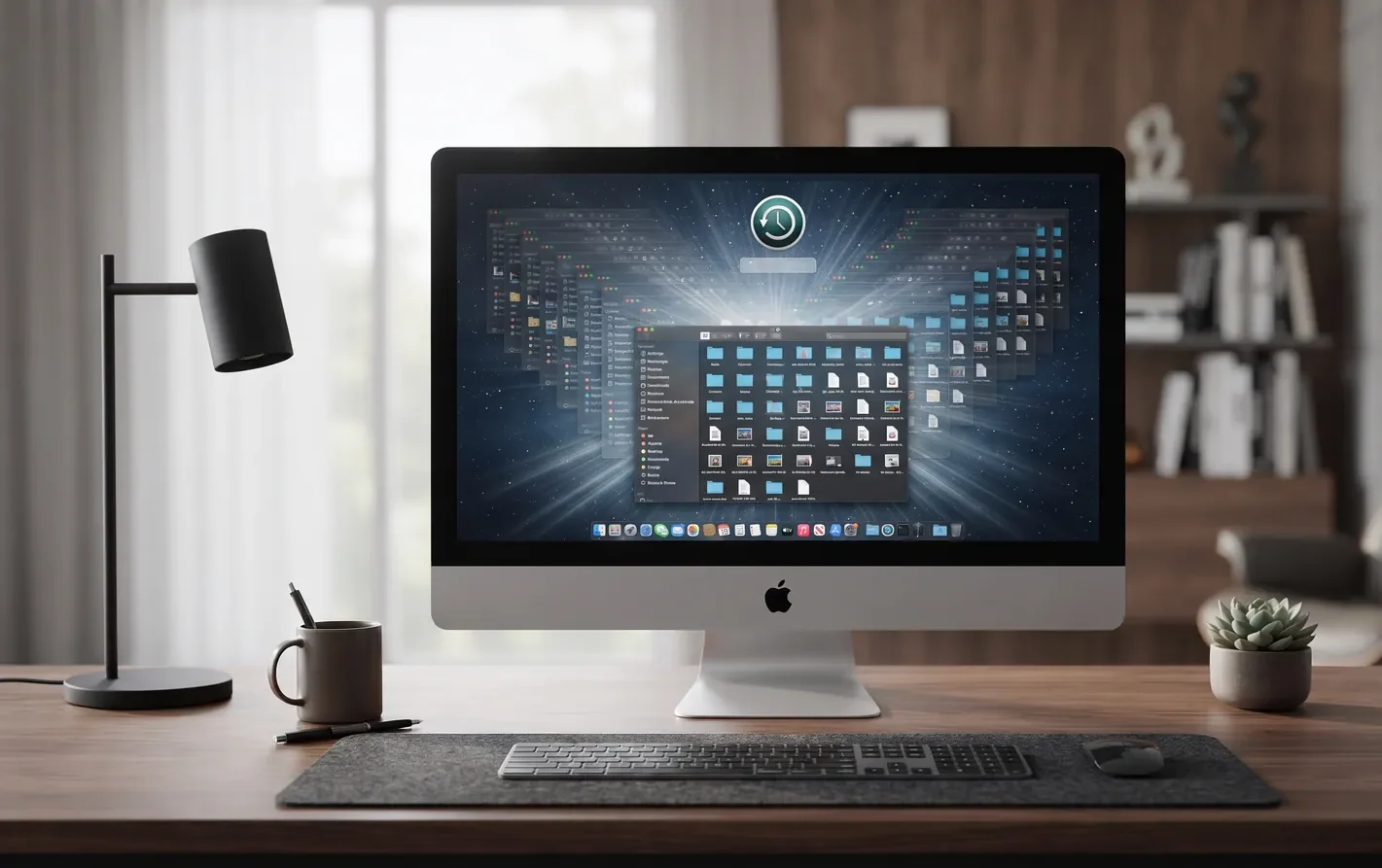
- Open the location where the deleted folder used to be in Finder, then enter Time Machine from the menu bar clock icon.
- Browse back in time using the timeline to a point before the deletion.
- Select the folder and click Restore — it returns, with all its contents, to its original place.
Time Machine can recover folders deleted long ago, making it the single best reason to keep it running. It's the go-to when the Trash has been emptied.
Way 3: iCloud Drive
If your folder lived in iCloud Drive, it has its own safety net:
- Open the Files app or iCloud.com and check Recently Deleted — folders and files deleted from iCloud Drive are kept for about 30 days and can be restored.
- iCloud.com's Data Recovery options can also restore files.
If the folder was synced to iCloud, it may still be sitting in Recently Deleted, ready to restore — no software needed.
When the top 3 aren't enough
If you've emptied the Trash, have no Time Machine backup, and the folder wasn't in iCloud, the built-in routes can't help — but there's still a fallback:
- Recovery software. Tools like Disk Drill, Data Rescue, and the free PhotoRec can scan the drive for the deleted folder's contents and recover them to a different drive. Stop using the Mac first, and recover to a separate drive.
- The limit on Apple Silicon. On a healthy Apple Silicon Mac's internal SSD with no backup, TRIM and encryption often make deleted data unrecoverable even by software. This is exactly why Time Machine and iCloud matter so much.
If you've emptied the Trash with no Time Machine or iCloud copy, and it's an Apple Silicon Mac, software recovery may not succeed. Stop using the Mac to avoid overwriting, and for irreplaceable data, consult a lab. See our Mac data recovery service.
When to call a lab
Most deleted-folder recoveries are handled by the top 3 methods. Call a lab when the folder is irreplaceable and the built-in methods and software have failed, when the Mac's drive is failing, or when the Mac is damaged. Labs can perform deeper recovery, working at board level on a damaged Mac to reach its storage — but for everyday deletions, the free built-in methods above usually do the job.
CBL's cleanroom lab recovers data from Macs when the built-in tools can't — free diagnosis, fixed quote before any work.
- WhatsApp: +65 8127 7508
- Call: +65 6588 0261

How to make Mac folder recovery effortless
- Keep Time Machine running — it makes almost any deletion a quick restore.
- Use iCloud Drive for a cloud safety net with a 30-day Recently Deleted window.
- Don't empty the Trash reflexively — it's a free undo.
- Keep a second backup, so even a failed Mac doesn't cost you. See our data backup tactics.