
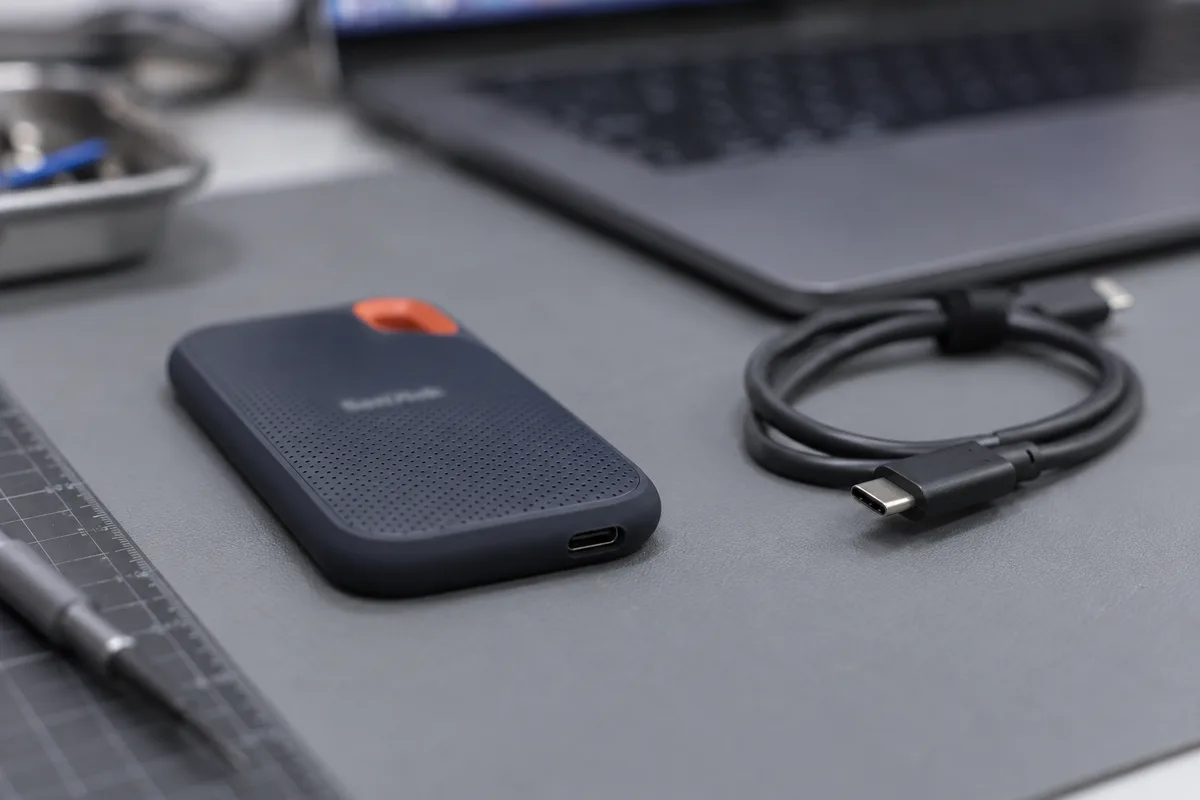
A portable SSD is not an SSD in a box, and that changes everything about recovering it.
When a portable hard drive stops being recognised, there is usually a straightforward first move: open the plastic shell, lift out the 2.5-inch drive inside, and connect it directly. On most modern portable SSDs that move does not exist.
Open one up and there is frequently no drive to remove. The flash memory, the controller that manages it and the USB interface are all soldered to a single small board — and on the smallest models they are fused into one moulded package. There is nothing to unplug and re-plug somewhere else.
That is why a portable SSD that has stopped mounting is a lab problem rather than a cable problem, and why the shops that will happily swap an enclosure for you often cannot help. We recover portable SSDs in our own Singapore cleanroom lab, across USB-A, USB-C, USB4 and Thunderbolt models from every mainstream brand.
If your drive is an external hard drive (it spins, it has weight to it, it is usually 2.5 inches and heavier than a phone), that is a different job with a different price — read that page instead. For a drive fitted inside a computer, see SSD data recovery or NVMe recovery.
What NOT to do with a failed portable SSD
Portable SSDs punish trial and error harder than hard drives do, because the controller can quietly reorganise or discard data while you are still trying things.
- Do not click “Format” or “Initialise”. Windows, macOS and mobile phones all offer it the moment a drive looks unreadable. Accepting it on an SSD is far worse than on a hard drive — the erase is passed through to the flash and the affected blocks are wiped rather than merely unlinked.
- Do not keep re-plugging it. Every time the drive powers up, its controller runs housekeeping: it re-reads its mapping tables, and if it is mid-failure it may rebuild or overwrite them. A drive that could be read on attempt three is sometimes unreadable by attempt thirty.
- Do not run recovery software against a drive that is dropping out. Software cannot fix a controller fault, and a long scan holds the drive at temperature and load for hours — which is exactly when a marginal controller dies for good.
- Do not put it in the freezer. That advice was always poor, and on an SSD it does nothing at all. There is no seized motor and no sticking head; condensation is the only thing you will achieve.
- Do not let anyone swap the board. Most portable SSDs encrypt in hardware by default, with the key tied to the controller. Move the flash to another board and the data becomes unreadable ciphertext — permanently.
Disconnect it, leave it disconnected, and bring it in. The diagnosis is free and it tells you what state the drive is actually in before anything is attempted.
Why portable SSDs behave differently from every other drive
Four things separate a portable SSD from the internal drives it appears to resemble. Together they explain most of what makes these cases difficult.
1. There is often no drive to remove
Portable SSDs fall into three broad builds. Some — typically the larger, older or professional models — genuinely contain an M.2 stick plugged into a bridge board, and those are the most recoverable. Many contain a single board carrying the flash, the controller and the USB connector together. The smallest and cheapest are monolithic: the controller and NAND are sealed in one moulded chip, with only test pads to work from. Which of the three you own decides almost everything about the job, and it cannot be told from the outside — which is one reason the diagnosis is free.
2. Many speak USB natively, with no drive protocol underneath
In a portable hard drive there is a real SATA drive behind a USB bridge; remove the bridge and a standard drive remains. In a native-USB portable SSD the flash controller speaks USB itself. There is no SATA or NVMe device hiding behind it, so there is nothing to expose by removing anything.
3. Hardware encryption is usually on, whether you set a password or not
Most current portable SSDs encrypt their contents by default. If you never set a password, the key is held by the controller and you never notice. That is invisible while the drive works and decisive when it fails: the data cannot be read off the flash chips alone, because what is stored there is ciphertext. Recovery has to go through the original controller, or recover the key from it. This is the single most common reason a portable SSD is unrecoverable when a chip-off has already been attempted elsewhere.
4. TRIM works over USB now, and it is fast
Older USB enclosures could not pass TRIM through, which is why deleted files often survived on external drives long after they would have gone from an internal one. Modern portable SSDs using UASP do pass it. If you have deleted something by accident, the window is minutes, not days — unplug the drive immediately rather than researching it while it stays connected.
Why portable SSDs fail
These are the presentations we actually see, roughly in order of how often they arrive.
- Controller failure — the drive is simply not there. No drive letter, nothing in Disk Management or Disk Utility, sometimes not even a power LED. The flash is usually intact; the part that knows how to reach it is not.
- Connector damage. Portable SSDs live in bags and pockets, and the USB-C socket is soldered to the same board as everything else. A socket pulled loose by a yanked cable is a board-level repair, not a cable swap. Intermittent connection, or working only when the cable is held at an angle, is the giveaway.
- “You need to format the disk before you can use it”. The drive is detected and reports its size, but the file system is unreadable. Usually a mapping-table or partition problem, and usually recoverable — provided nobody accepts the format.
- Wrong capacity reported. A 2 TB drive showing as 8 MB, 32 MB or 0 bytes means the controller has fallen back to a safe mode after failing to load its own configuration.
- Unplugged mid-write. The most preventable cause. Pulling a portable SSD out during a large copy, or while a phone or camera is still writing, can leave the mapping tables half-updated.
- Heat and sustained writes. Small metal-bodied drives run hot under long transfers — video offloads are the usual culprit — and heat shortens controller life.
- Worn flash. Genuinely rare in consumer use and much less common than people assume, but real in drives used for daily scratch work over several years.
- Liquid and impact. Rugged models survive a great deal, but a rating covers a sealed, undamaged case — not one that has already been dropped hard enough to crack it.
Portable SSD brands and models we work on
The list below is there so you can check your own model rather than guess. It is not exhaustive and it does not need to be — if your drive is a portable SSD, bring it in. We also work on models that have been discontinued, on regional variants, and on drives bought overseas.
What matters more than the brand is which of the three builds your drive uses, and whether hardware encryption is active. Both are determined during the free diagnosis, and both are stated in the written quote before any work begins.
| Brand | Portable SSD models and series |
|---|---|
| SanDisk | Extreme Portable SSD, Extreme PRO Portable SSD, Extreme PRO V3, Extreme PRO with USB4, Extreme Go, Creator PRO, Creator Phone SSD, Phone SSD, Extreme Portable SSD for PlayStation |
| SanDisk Professional | PRO-G40 SSD |
| Samsung | Portable SSD T9, T7 Shield, T7, T7 Touch, T5, X5 |
| Crucial | X10, X10 Pro, X9, X9 Pro, X9 Pro for Mac, X8, X6 |
| Western Digital / WD | My Passport SSD, WD_BLACK P40 Game Drive SSD |
| Seagate | One Touch SSD |
| LaCie | Portable SSD, Rugged Mini SSD, Rugged SSD, Rugged SSD Pro |
| Kingston | XS1000, XS2000 |
| Lexar | SL500, SL500 Magnetic Set, SL600, SL300, ES3, ES5 Magnetic, Air Portable SSD, ARMOR 700, Professional Go, Professional Go with Hub, Professional Workflow, SL500 Elite Legends |
| ADATA | SE920, SD820, SD810, SC750, SC740, SC730 |
| Transcend | ESD420, ESD410C, ESD400, ESD380C, ESD360C, ESD350C, ESD270C, ESD265C, ESD260C, ESD250C, ESD240C, ESD230C, ESD220C, StoreJet 500 |
| Corsair | EX400U, EX100U |
| KIOXIA | EXCERIA PLUS G2 Portable SSD, EXCERIA PLUS Portable SSD |
| SK hynix | Beetle X31 |
| PNY | RP60 Rugged, Pro Elite V2, EliteX-PRO, Pro Elite, Elite Portable SSD |
| Sabrent | Rocket Nano SSD, Rocket Nano Rugged SSD |
| Silicon Power | PX10, DS72, PC60 |
| TEAMGROUP / T-CREATE / T-FORCE | PD40 Mini, PD20 Mini, PD20 ECO Mini, PD20M Mag, P31, EXPERT P35S, EXPERT P34F Find My, X2 MAX, M200, CLASSIC Thunderbolt 3, EXPERT P32 Desk SSD |
| OWC | Envoy Ultra, Express 1M2 80G, Express 1M2 USB4, Envoy Pro FX, Guardian, Envoy, Envoy Pro Elektron, Envoy Pro mini, Envoy Pro SX |
| MSI | DATAMAG 40Gbps, DATAMAG 20Gbps |
| ASUS / ROG | ROG Strix Arion S500 |
| Verbatim | Store 'N' Go Mini Stripe SSD, Store 'N' Go USB 3.2 Portable SSD, Vx500 External SSD |
| Buffalo | SSD-PG, SSD-PUT, SSD-PHO, SSD-SAO |
| Netac | Z Slim, Z9, Z7S, ZX, Z6S, Z11, ZX10, ZX20, ZX20L |
| ORICO | M20 Portable SSD, A20 Portable SSD |
| Patriot | PXD Portable External SSD (discontinued) |
All product and company names above are trademarks of their respective owners and are used here only to describe the devices we service. CBL Data Recovery is an independent data recovery laboratory and is not affiliated with, authorised by, or endorsed by any of these manufacturers. Sending a drive to us is separate from any manufacturer warranty — see the FAQ below.
How a portable SSD case runs
- Free diagnosis. We identify the build (M.2 inside, single board, or monolithic), check whether the controller responds at all, and establish whether hardware encryption is in play. Nothing is charged and nothing is opened beyond what the assessment needs.
- Fixed written quote. You get a price, a realistic expectation of what can be recovered, and a turnaround. The price does not move afterwards. If we do not think it is recoverable, we say so at this point rather than billing you to find out.
- You decide. Nothing proceeds without your approval, and there is no charge for stopping here.
- Recovery. Depending on the build, that means working through the original controller, repairing the board so the controller can be used again, or, on monolithic drives, reading the device through its test pads and reconstructing the translation layer. Encrypted drives are decrypted using the key recovered from the original controller — never by moving the flash elsewhere.
- Verification and return. You get a file listing to confirm the data is what you needed before you pay. Recovered data is returned on media we supply, and your original drive comes back with it.
Turnaround is typically 2–5 working days for logical and controller-level cases. Monolithic reads and board repairs take longer; the quote will say so rather than leaving you guessing. Emergency handling is available.
What portable SSD recovery costs
Price follows the build and the failure, not the capacity of the drive. The three bands we quote against are:
- Logical. The drive is detected and readable but the file system is not — a format that was accepted, a corrupted partition, files deleted by mistake. The least expensive band.
- Controller-level. The drive is not detected, or reports the wrong capacity. Work goes through the controller or through a board repair that brings it back. This is the most common band for portable SSDs.
- Monolithic or severe physical. No usable controller, a cracked board, or a drive that has to be read through its test pads. The most demanding band, and the one where a previous attempt elsewhere most often decides the outcome.
Every case gets a fixed written quote before any work starts, and the free diagnosis is what produces it. There is no charge if you decide not to proceed. See data recovery pricing for how we quote across all media types.
Free diagnosis & a fixed written quote
Bring the drive in, or send it. The assessment costs nothing, tells you what has actually failed, and comes with a price that will not change. The sooner a portable SSD stops being powered on, the more of it there usually is to recover.
Portable SSD recovery FAQ
My portable SSD is not showing up at all. Is the data gone?
Usually not. On a portable SSD the flash normally survives; what fails is the controller or the board around it. A drive that is invisible to the computer is a controller problem, not evidence that the data has been erased. The free diagnosis establishes which it is.
Can I just open the case and plug the drive into my computer?
On a portable hard drive, often yes. On most portable SSDs there is nothing inside to plug in anywhere — the flash, the controller and the USB connector are one board. Opening the case also voids the warranty and risks the connector. If your model does contain a removable M.2 stick, hardware encryption usually still prevents another machine from reading it.
Windows is asking me to format the drive. Should I?
No. That message means the file system cannot be read, not that the data has gone. Accepting the format on an SSD is worse than on a hard drive, because the erase reaches the flash itself. Disconnect the drive and have it looked at.
I deleted files from my portable SSD by accident. How long do I have?
Minutes. Modern portable SSDs pass TRIM through over USB, so deleted data is purged quickly rather than lingering the way it used to on external drives. Unplug the drive immediately — do not keep it connected while you read about what to do.
Does sending it to you void my warranty?
Opening any drive voids its warranty, which is true of every recovery lab, including the manufacturer's own. It is worth knowing that a warranty replacement gives you a new empty drive, not your data — manufacturers do not return the contents. If the data matters, recover first and claim afterwards.
My drive was password-protected. Can you still recover it?
If you know the password, yes — tell us and it is a normal case. If you do not know it, the answer is usually no, and any lab that promises otherwise is not being straight with you. Hardware encryption on these drives is doing exactly what it was sold to do.
Another shop already tried. Does that matter?
It can. A failed chip-off on an encrypted drive is often unrecoverable afterwards, because the controller holding the key has been destroyed. Tell us what was already attempted — it changes the assessment, and we would rather know at the start.
Do you work on rugged models like the T7 Shield or Extreme Portable?
Yes. A rugged rating covers a sealed, intact case; it does not make the controller inside any more durable, and these models reach us with the same controller and connector faults as any other portable SSD.
What we do — and what we don't
We do: recover data from NVMe drives in every common form factor — M.2 2230 through 22110, U.2 and U.3, add-in cards, and NVMe soldered to a mainboard — across PCIe 3.0, 4.0 and 5.0, covering controller failures, translator corruption, worn QLC and TLC flash, and file system damage on NTFS, APFS, ext4 and ZFS.
We do not: sell SSDs, build PCs, or break encryption. If your drive is healthy and you simply want a faster one, that is a retailer's job. If your volume is encrypted you need the key, and you should be wary of anyone who says otherwise.